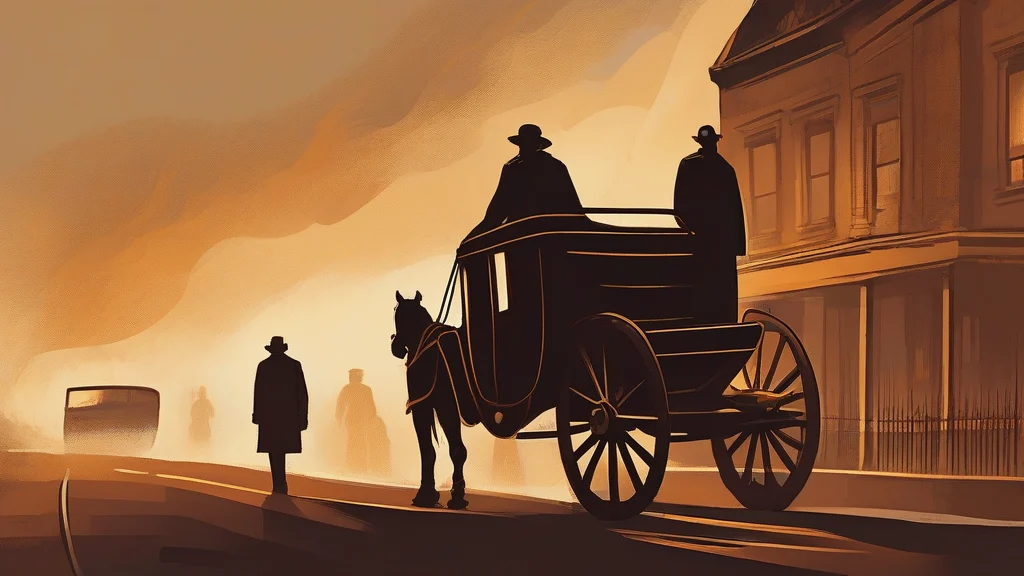
What does cabman mean?
A cabman is a man whose job is driving a cab — originally a horse-drawn hansom or hackney carriage, later a motorised taxicab — for paying passengers. The word was common throughout the nineteenth and early twentieth centuries, particularly in Britain, when hansom cabs and growlers dominated urban transport and the cabman was a familiar figure of city life. Today it has a distinctly period feel: modern English speakers are far more likely to say 'taxi driver' or the colloquial 'cabbie', so 'cabman' now survives chiefly in historical writing, classic literature, and nostalgic contexts. It nonetheless remains a precise and evocative term, instantly summoning an image of a moustached driver on a high box seat navigating gaslit streets. The plural is 'cabmen'. For readers of Victorian fiction or social history, knowing the word adds texture; for writers, it lends scenes an authentic air of the age when the rattle of hooves, not engines, filled the streets.
nounA man whose occupation is driving a cab (a taxi or horse-drawn carriage) for hire.
- A man who drives a taxicab or other hired vehicle for a living.
- (Historical) A man who drove a horse-drawn cab or hansom carriage.
"The cabman knew every shortcut in the city and had the passenger at the station well before his train departed."
"The cabman helped lift her heavy suitcase into the boot of the taxi before setting off towards Paddington."
"In Conan Doyle's stories, a sharp-eyed cabman often proves to be the most reliable witness on London's streets."
The regular masculine-agent plural in -men; used identically to the singular but for multiple drivers.
"Dozens of cabmen lined the rank outside the railway station at dawn."
London's Victorian cabmen were so notorious for overcharging that the city built tiny green huts — 'cabmen's shelters' — where drivers could grab a cheap meal without being tempted into the pub.
Reviewed by Deb Chak, Editor. AI-assisted content curated by RJS Tech Solutions LLP.
Etymology of cabman
The word 'cabman' is a straightforward English compound formed from 'cab' — itself a shortening of 'cabriolet', borrowed from French in the early nineteenth century — combined with 'man'. The French 'cabriolet' derives ultimately from 'cabriole', related to 'cabrioler' ('to leap, caper'), from Latin 'capra' ('goat'), reflecting the light, springy motion of the original two-wheeled carriage. As motor taxis replaced horse-drawn cabs, the compound simply transferred to the new vehicle's driver. Its cognates therefore include other words descending from the Latin root for goat, such as 'caprine' and 'caper'.
Related word forms
How cabman is actually used
Somewhat dated or literary in tone today; modern usage prefers 'taxi driver' or the informal 'cabbie'. The plural is 'cabmen'. The word carries a faintly old-fashioned, often British flavour, evoking the era of Hansom cabs.
Easily confused with cabman
A cabin is a small room or dwelling, while a cabman is a person who drives a cab for a living.