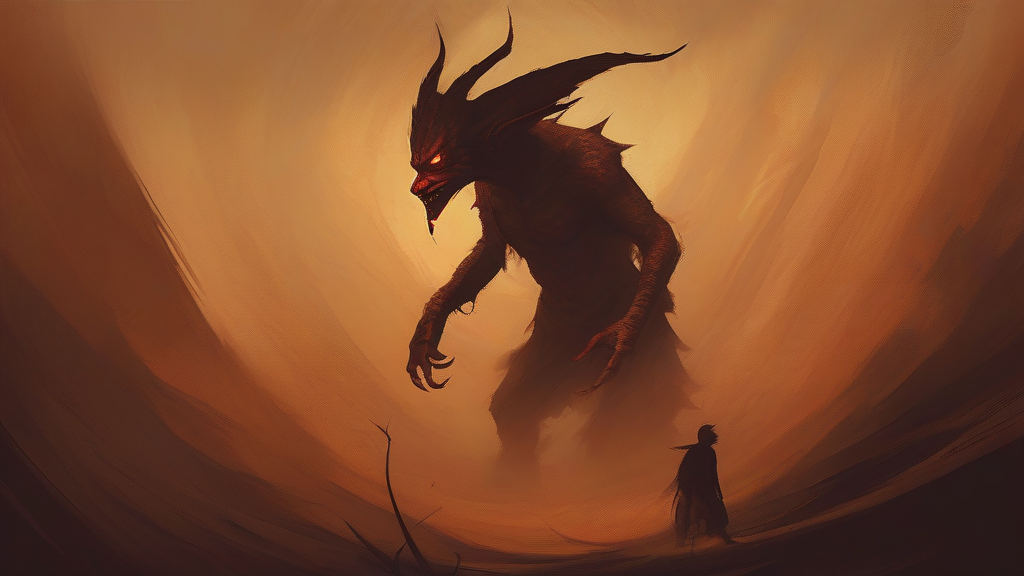
What does cacodaemon mean?
A cacodaemon is an evil spirit or malevolent demon, a term inherited from ancient Greek belief in guardian spirits. Where a 'eudemon' was a kindly spirit that guided a person toward good fortune, the cacodaemon was its dark counterpart — a malignant presence blamed for misfortune, temptation, and moral corruption. The word later broadened figuratively to describe a thoroughly wicked person, someone who seems to embody evil itself. Today it is rare and decidedly literary: it surfaces in historical discussions of demonology, in Gothic and fantasy fiction, and in scholarly writing on classical religion, where its archaic ring is part of its appeal. Its unmistakably sinister connotation makes it useful when a writer wants a weighty, learned alternative to plainer words like 'devil' or 'fiend'. The variant spelling 'cacodemon' is equally accepted.
nounAn evil spirit or malevolent demon; a person of wicked, malign character.
- An evil spirit or malignant demon in classical and occult belief.
- A wicked, malevolent person; an embodiment of evil.
"The old superstition held that a cacodaemon lurked in the abandoned mill, souring everything it touched."
"Medieval theologians catalogued the cacodaemon among the fallen spirits that tempted humankind toward ruin."
"In the novel's final chapter, the villain stands revealed as little more than a cacodaemon in human form."
The standard English plural simply adds -s; the variant spelling 'cacodemons' is also found.
"The grimoire described a host of cacodaemons, each assigned to torment a particular sinner."
In Renaissance astrology, every person was thought to be governed by either a eudemon (good spirit) or a cacodaemon — an evil one — deciding their fortune from birth.
Reviewed by Deb Chak, Editor. AI-assisted content curated by RJS Tech Solutions LLP.
Etymology of cacodaemon
Cacodaemon derives from Greek 'kakos' meaning bad or evil, combined with 'daimon', the Greek term for a divine or semi-divine spirit. The compound passed into Latin and entered English usage during the Renaissance period, when interest in classical daemonology flourished. It shares the Greek root 'kakos' with words such as 'cacophony' and stands as the direct opposite of 'eudemon', which combines the same second element with 'eu-', meaning good.
Related word forms
How cacodaemon is actually used
A rare, learned word drawn from classical Greek via Latin. It carries a strongly negative, archaic flavour and appears mostly in literary, historical, or occult contexts rather than everyday speech. The spelling 'cacodemon' is a common variant.
Easily confused with cacodaemon
An eudemon is a benevolent, good spirit, the opposite in kind to the evil cacodaemon.