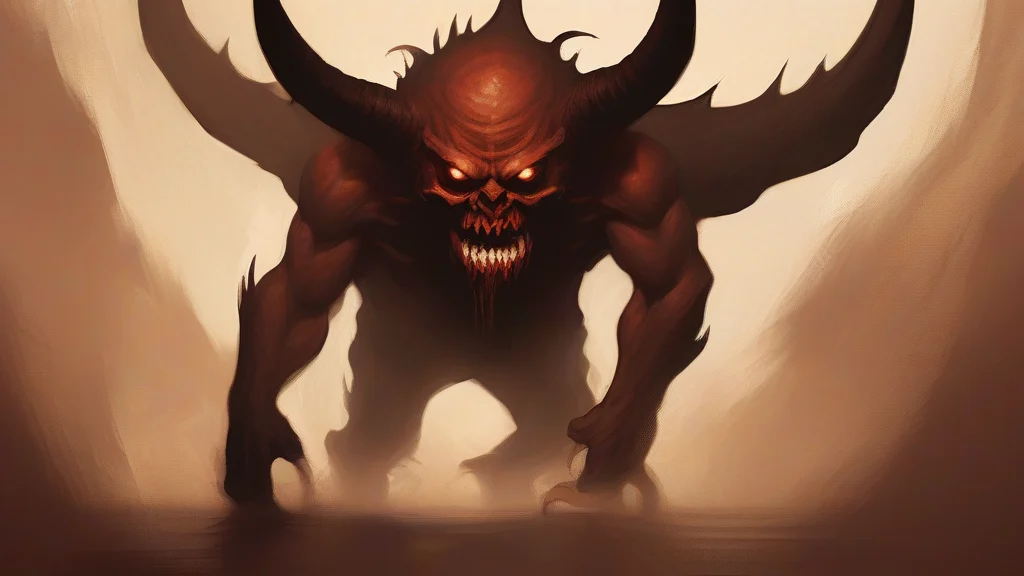
What does cacodemon mean?
A cacodemon is an evil spirit or malevolent demon, a word drawn from ancient Greek that has long haunted religious texts, magical treatises, and works of fiction. The term comes from the Greek 'kakos' (bad) combined with 'daimon' (spirit), literally meaning a wicked or harmful supernatural being. Historically, it appeared in medieval theology and Renaissance occultism, where demons were catalogued and their influence over human affairs debated; practitioners of ceremonial magic even devised sigils intended to bind such spirits to their will. Today, cacodemon survives mainly as a rare, learned term encountered in demonology, Gothic literature, fantasy games, and scholarly writing about superstition. It connotes active malice rather than mere mischief, setting it apart from trickster figures like imps or pixies. For readers interested in the history of ideas about evil spirits, it offers a precise, evocative label for the darkest class of supernatural beings.
nounAn evil spirit or malignant demon; a malevolent supernatural being.
- An evil or malignant spirit; a malevolent demon in religious, mythological, or occult contexts.
"The medieval manuscript described the cacodemon as a spirit that whispered doubts into the dreams of the faithful."
"The old grimoire warned that a cacodemon, once summoned, would twist every wish into a curse."
"Medieval theologians debated whether madness was the work of a cacodemon or an imbalance of the body's humors."
Standard pluralization; occasionally the Latin-style plural 'cacodemones' appears in older occult texts, but 'cacodemons' is the normal modern form.
"The fresco depicted a host of cacodemons tormenting the damned."
In Renaissance magic, magicians drew elaborate seals to command cacodemons — but one wrong stroke of the pen was said to turn the summoner from master to victim.
Reviewed by Deb Chak, Editor. AI-assisted content curated by RJS Tech Solutions LLP.
Etymology of cacodemon
The word derives from Greek 'kakodaimon', formed from 'kakos' meaning bad or evil and 'daimon' meaning spirit or divine being. It passed into Latin and then into English, where it became established by the sixteenth century in writings on religion and the occult. Its sibling term 'agathodemon', denoting a good spirit, shares the same construction, and the root 'kako-' also appears in words like cacophony and cacography.
Related word forms
How cacodemon is actually used
A rare, learned word found chiefly in historical, literary, and occult writing rather than everyday speech. It carries a strongly negative connotation and often appears in discussions of demonology, Renaissance magic, or Gothic fiction.
Easily confused with cacodemon
An agathodemon is a benevolent or good spirit in Greek belief, the direct opposite of the malevolent cacodemon.