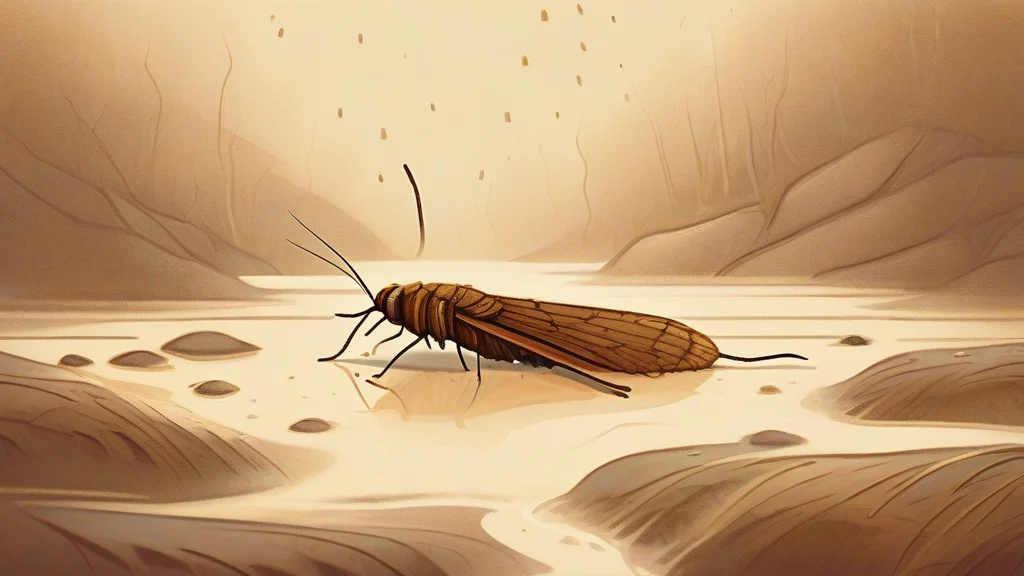
What does caddisfly mean?
The caddisfly is a small, inconspicuous insect of the order Trichoptera, best known to most people through its aquatic larval stage. Adult caddisflies are moth-like in appearance, with dull, hairy wings held roof-like over the body, and they are typically active near water at dusk. The larvae live in streams, rivers, lakes, and ponds, where many species spin silk to build remarkable protective cases out of sand grains, pebbles, twigs, or plant fragments. Anglers know caddisflies intimately, since they form a major part of freshwater fish diets, and artificial flies imitating them are staples of fly-fishing. Ecologists prize them too: because many species cannot tolerate pollution, the presence or absence of caddisfly larvae serves as a reliable indicator of water quality. Though rarely noticed by the general public, the insect plays a significant role in freshwater food webs and in monitoring environmental health.
nounA small moth-like insect of the order Trichoptera, having two pairs of hairy wings and aquatic larvae that typically construct protective cases from silk, sand, or plant debris.
- Any insect of the order Trichoptera, characterized by hairy wings and aquatic larvae.
- (In angling use) an artificial fishing fly designed to imitate a caddisfly or its larvae.
"The trout rose steadily to the evening hatch of caddisflies."
"Biologists counted dozens of caddisfly species in the clean, fast-flowing stream."
"He tied on a caddisfly pattern just as the fish began rising to the evening hatch."
Standard plural, formed regularly by adding -es to 'fly'; 'caddises' is not used.
"On warm summer evenings, clouds of caddisflies gather above the riverbank."
Caddisfly larvae are nature's architects — they glue grains of sand and bits of twig into portable cases around their bodies, and some artists have even had them build jewel-encrusted versions using flakes of gold.
Reviewed by Deb Chak, Editor. AI-assisted content curated by RJS Tech Solutions LLP.
Etymology of caddisfly
The word combines 'fly' with 'caddis', a Middle English term recorded from the fifteenth century meaning worsted yarn or braided cord — a reference evidently suggested by the silken, cord-like larval cases. The ultimate origin of 'caddis' itself is uncertain, though it has been linked to Old French words for ribbon or braid. The compound 'caddisfly' arose in English natural-history writing to distinguish these insects from true flies and moths, while anglers independently preserved the older short form 'caddis'.
Related word forms
How caddisfly is actually used
The word is chiefly technical and naturalist vocabulary, common in entomology, freshwater ecology, and fly-fishing circles. In British angling tradition, adults are often simply called 'sedges'. Because caddisfly larvae are sensitive to pollution, their presence is widely used as an indicator of good water quality. The plural is 'caddisflies', though 'caddis' alone frequently stands in informally among anglers.
Easily confused with caddisfly
A mayfly is a different aquatic insect (order Ephemeroptera) with transparent, upright wings and no larval case-building behavior.
Though caddisflies resemble small moths in appearance, they belong to an entirely separate insect order (Trichoptera) and have hairy rather than scaly wings.