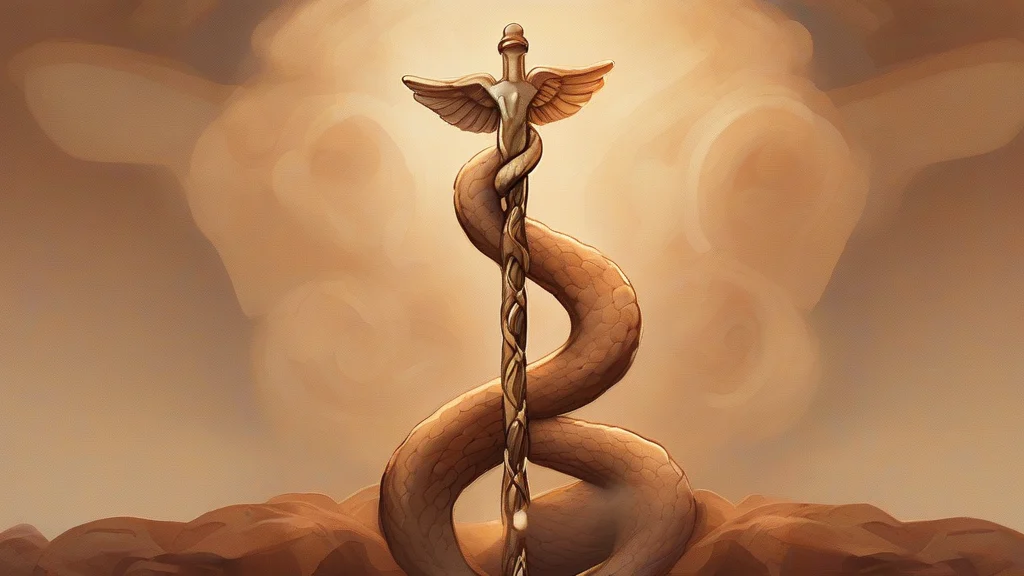
What does caduceus mean?
The caduceus is the ceremonial staff traditionally carried by Hermes, the Greek god who served as messenger of the gods (identified by the Romans with Mercury), and by the heralds who acted under his authority. It is typically shown as a short rod with two snakes coiled around it in opposing spirals and a pair of wings at the crown. In classical antiquity it signified peaceful negotiation, safe conduct, and the authority of the envoy, and it later became an emblem of commerce, printing, and diplomacy. In modern times, particularly in the United States, the caduceus has also been widely adopted as a symbol of the medical profession, largely through military and commercial usage in the nineteenth century. This has made it a source of frequent confusion with the staff of Asclepius — a plain rod with a single serpent and no wings — which is the older and more strictly correct emblem of healing. The word itself comes from the Latin caduceus, and its plural is caducei.
nounA caduceus is the traditional staff of Hermes (Mercury), carried by a herald and depicted as a short wand with two snakes entwined around it and a pair of wings at the top. It has long served as an emblem of commerce, negotiation, and heraldry.
- The winged staff with two entwined serpents borne by Hermes/Mercury as messenger of the gods and patron of heralds.
- An emblem or insignia adopted from that staff, used in modern times variously to represent commerce, diplomacy, printers, and — controversially — medicine, especially in the United States.
"The engraver stamped a tiny winged caduceus beside the merchant's mark on the coin."
"Above the customs house doorway, a bronze caduceus announced the building's role in trade and official communication."
"The medical school's crest paired a book and lamp with a caduceus, though classicists noted the older emblem of healing was the serpent-entwined rod of Asclepius."
The conventional plural preserves the Latin ending; 'caduceuses' is occasionally seen in informal writing but is widely regarded as awkward.
"The museum displayed bronze caducei recovered from several Roman sites."
The snake-twined staff you've probably seen at your doctor's office is very likely the wrong one — medicine's real symbol is the single-snake staff of Asclepius, while the double-snake, winged caduceus actually belongs to Hermes, god of merchants and thieves.
Reviewed by Deb Chak, Editor. AI-assisted content curated by RJS Tech Solutions LLP.
Etymology of caduceus
English borrowed 'caduceus' directly from Latin in the early seventeenth century, where it named the herald's wand of Mercury. Its ultimate origin within Latin is debated among scholars; it may be connected to Greek vocabulary for heralds' staves, though the derivation is not securely established. Because of this uncertainty, confident English cognates are few. The standard plural follows the Latin second-declension pattern: caducei.
Related word forms
How caduceus is actually used
A learned, somewhat formal word, familiar mainly from classical studies, numismatics, and discussions of symbolism. In British usage it remains primarily associated with Hermes and heraldry; in American usage its association with medicine is far more widespread, which often prompts commentary about whether that association is historically apt.
Easily confused with caduceus
The staff of Asclepius bears a single snake and no wings and is the true symbol of medicine, whereas the caduceus has two snakes and wings and represents Hermes, heraldry, and commerce.