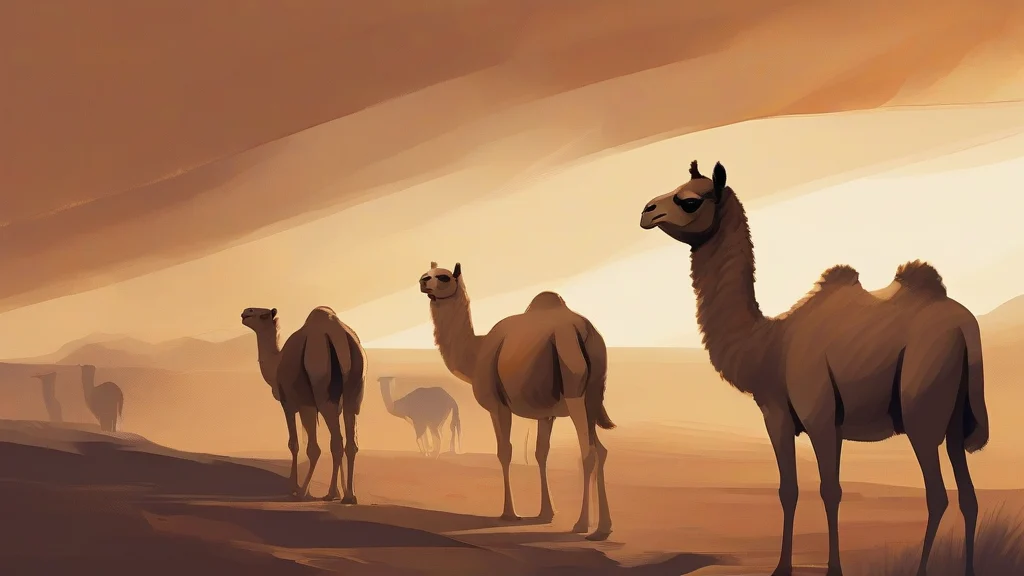
What does camelid mean?
A camelid is any member of Camelidae, the mammal family that unites the world's camels with their surprising South American cousins. The group includes two Old World species — the one-humped dromedary and the two-humped Bactrian camel — along with four South American members: the llama, the alpaca, and their wild relatives the guanaco and the vicuña. All camelids share distinctive traits: long necks, padded feet rather than hooves, and a three-chambered stomach instead of the four found in true ruminants. The word is primarily technical, appearing in zoological literature, veterinary practice, and farming contexts; everyday speech usually names the animal directly. Its usefulness lies in precision — it lets writers discuss the entire family at once, as when describing how domesticated camelids have served Andean cultures for thousands of years.
nounA mammal belonging to the family Camelidae, a group of even-toed hoofed ruminants that includes camels, llamas, alpacas, guanacos, and vicuñas.
- Any member of the mammal family Camelidae, comprising Old World camels (dromedary, Bactrian) and South American camelids (llama, alpaca, guanaco, vicuña).
"Llamas and alpacas are domesticated South American camelids prized for their fleece."
"The vet specializes in camelids, treating everything from Bactrian camels to prize-winning alpacas."
"Unlike true ruminants, camelids have a three-chambered stomach rather than four."
Standard regular plural; commonly used when referring to multiple members of the family or discussing them as a class.
"South American camelids were domesticated by Andean peoples long before European contact."
Every llama, alpaca, guanaco, and vicuña in South America is technically a camel's cousin — the whole gang goes by one scientific-sounding word: camelid.
Reviewed by Deb Chak, Editor. AI-assisted content curated by RJS Tech Solutions LLP.
Etymology of camelid
The word derives ultimately from Latin camelus, meaning 'camel', which itself was borrowed from Greek kamēlos, likely of Semitic origin. Naturalists formed the modern term by combining this root with the zoological suffix -id, denoting membership in an animal family, to name the family Camelidae established during nineteenth-century taxonomic classification. English retains the shared root in 'camel' and, more distantly, in 'chameleon', whose Greek name means literally 'ground lion' but contains the same camel element.
How camelid is actually used
A technical term used chiefly in zoology, veterinary medicine, agriculture, and serious nature writing; it rarely appears in casual conversation, where speakers simply name the specific animal (llama, alpaca, etc.). It is always countable and typically pluralized when discussing the group.
Easily confused with camelid
A camel is one specific animal within the camelid group, whereas a camelid refers to any member of the wider biological family that also includes llamas, alpacas, guanacos, and vicuñas.