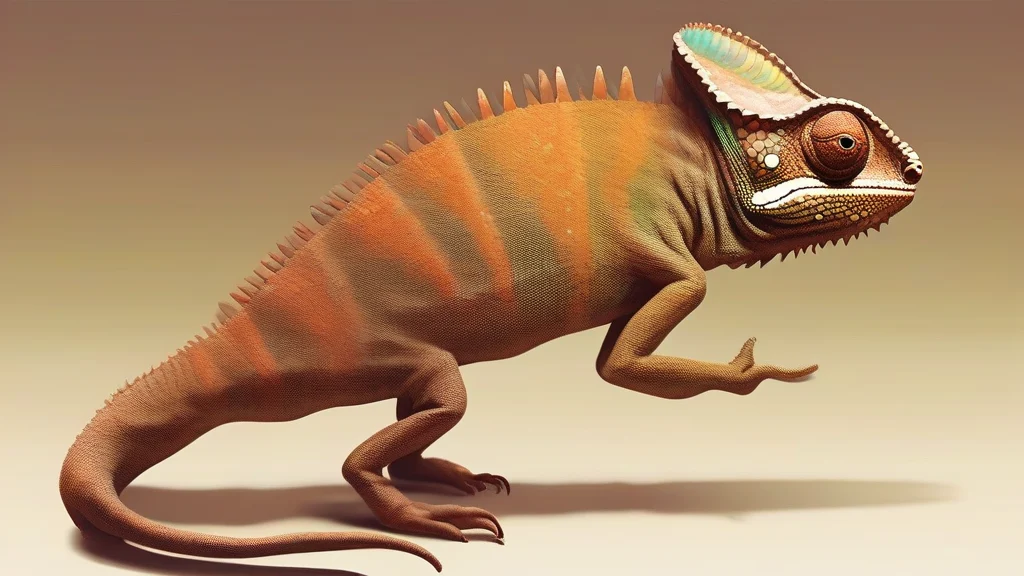
What does chameleon mean?
A chameleon is, first and foremost, one of nature's most recognisable lizards — an Old World reptile famed for shifting the colour of its skin, gripping branches with a prehensile tail, and scanning its surroundings with two independently moving eyes. Native mainly to Africa and Madagascar, chameleons have become a byword for adaptability. The word is also used figuratively to describe a person whose opinions, loyalties, or outward manner seem to change as often as circumstances demand; calling someone a 'political chameleon' implies inconsistency or opportunism, sometimes unfairly. In everyday speech the term bridges zoology and human character effortlessly, which is part of what makes it so useful. Whether describing a vividly coloured animal on a branch or a colleague whose positions shift with the wind, 'chameleon' evokes transformation, camouflage, and restless flexibility — qualities that fascinate biologists and intrigue observers of human behaviour alike.
Any of various small, slow-moving Old World lizards of the family Chamaeleonidae, characterised by the ability to change colour, a long sticky tongue, a prehensile tail, and eyes that move independently.
"We watched a chameleon stalk an insect across the branch before flicking out its tongue."
A person who changes their opinions, behaviour, or appearance readily to suit prevailing circumstances.
"He proved such a chameleon that no one could say what he truly believed."
Usually carries a negative connotation of unreliability or insincerity.
Regular plural; used for both multiple animals and, figuratively, multiple adaptable people.
"Chameleons from Madagascar display some of the most striking colour variation in the animal kingdom."
A chameleon doesn't change colour mainly for camouflage — most species shift hue primarily to regulate temperature and communicate with other chameleons.
Reviewed by Deb Chak, Editor. AI-assisted content curated by RJS Tech Solutions LLP.
Etymology of chameleon
'Chameleon' comes from the Latin 'chamaeleon', itself borrowed from Greek 'khamaileōn', meaning literally 'ground lion' — from 'khamai' ('on the ground') plus 'leōn' ('lion'). The Greek compound likely referred to the lizard's terrestrial habits rather than any leonine ferocity, since the animal is famously timid. English adopted the word via Latin in Middle English, and both the spellings 'chamaeleon' (closer to the Latin) and 'chameleon' remain accepted today. The same Greek root 'khamai' also appears in other learned words such as 'chamomile' ('ground apple').
Related word forms
How chameleon is actually used
Both senses are standard in British and American English. The figurative sense is common in journalism and political commentary and usually carries a mildly negative connotation of opportunism or insincerity, though it can occasionally be neutral or even admiring, suggesting adaptability.
Easily confused with chameleon
A cameo is a brief appearance or a carved gem, while a chameleon is either the colour-changing lizard or (figuratively) an adaptable, changeable person.