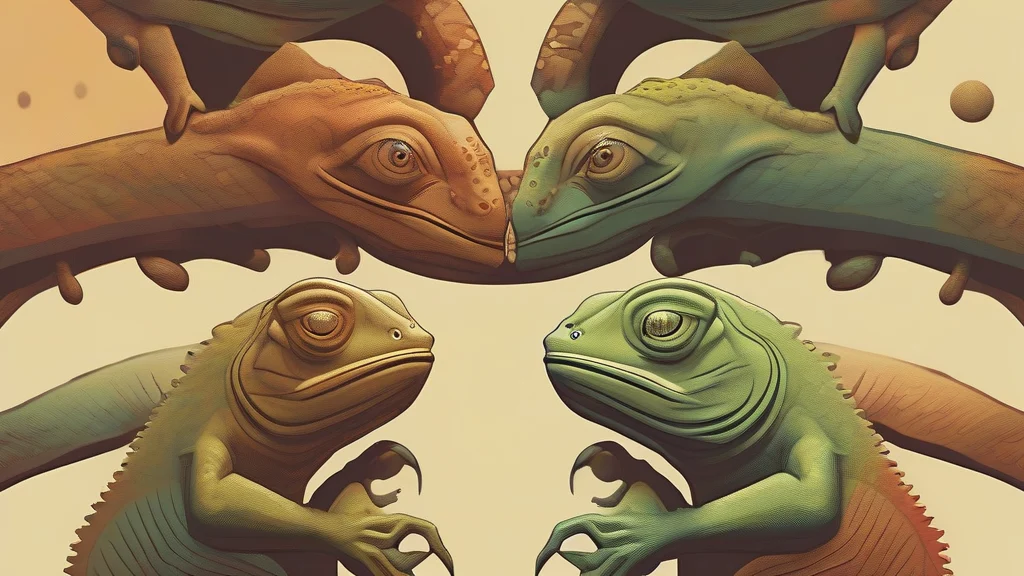
What does chameleonlike mean?
Chameleonlike is an adjective used to describe a person, organization, or thing that changes readily — in appearance, mood, opinion, or behavior — much as the chameleon famously changes its skin color. The word carries a built-in ambiguity: applied to an artist or performer, it suggests admirable versatility and range; applied to a politician or businessperson, it can imply opportunism or a lack of fixed principles. Typical contexts include descriptions of actors who disappear into their roles, leaders whose views shift with public sentiment, and designs or fashions that adapt seamlessly to their surroundings. Formed simply by attaching the suffix -like to chameleon, the term entered English relatively late and remains most at home in descriptive prose, reviews, and profile writing. It offers writers a vivid, compact way to signal transformative adaptability without resorting to plainer terms such as changeable or adaptable.
adjectiveResembling a chameleon, especially in changing one's appearance, opinions, or behavior to suit different circumstances; marked by frequent and often opportunistic changeability.
- Changing appearance, character, or behavior readily to suit circumstances; highly adaptable in a way reminiscent of the color-changing chameleon.
"Her chameleonlike ability to reinvent herself made her a fixture of the fashion world for three decades."
"The actor delivered a chameleonlike performance, vanishing completely into each role."
"His chameleonlike political positions shifted with whatever audience he happened to face."
The word traces back to Greek khamaileōn — literally 'ground lion' — so calling someone chameleonlike is secretly comparing them to a tiny earth-dwelling lion.
Reviewed by Deb Chak, Editor. AI-assisted content curated by RJS Tech Solutions LLP.
Etymology of chameleonlike
Chameleonlike is formed within English by adding the adjectival suffix -like to "chameleon." The noun chameleon derives via Latin chamaeleon from Greek khamaileōn, a compound of khamai ('on the ground, dwarf') and leōn ('lion'), so named for the small, ground-hunting species known to the Greeks. The Greek khamai- element also appears in chamomile (khaimaimelon, 'earth apple'), making these true relatives. The -like suffix comes from Old English gelīc, giving the word its Germanic adjectival ending atop a Greek-Latin base.
How chameleonlike is actually used
Somewhat formal to neutral in register; common in journalism and criticism. The connotation can be admiring (versatility, adaptability) or critical (opportunism, lack of principle), depending entirely on context.
Easily confused with chameleonlike
"Chameleon" is the noun naming the lizard itself (or figuratively a person who changes to fit in), while "chameleonlike" is an adjective describing anything that resembles that changeability.