What does chamaeleon mean?
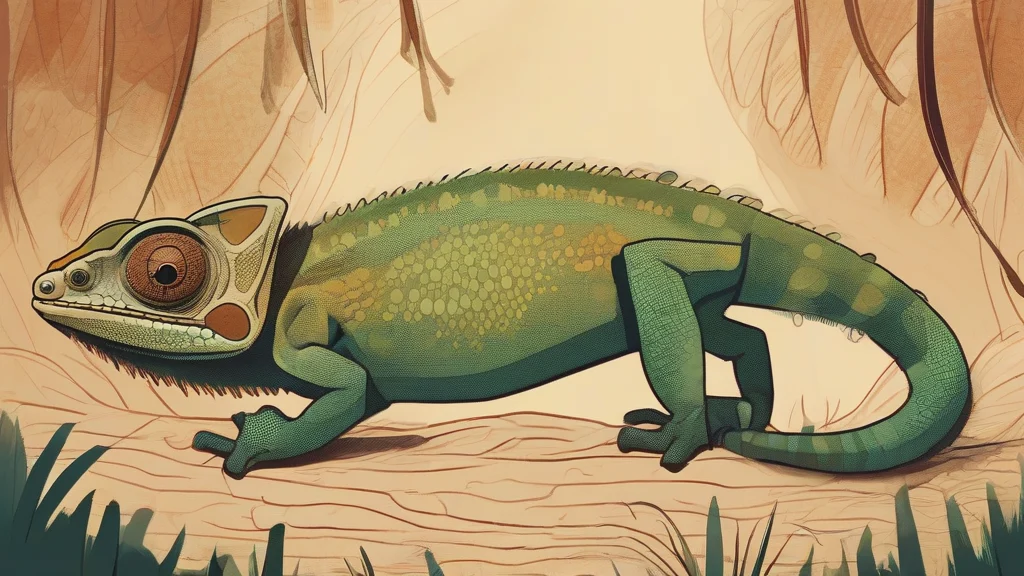
Chamaeleon is a variant, now largely non-standard, spelling of chameleon, the lizard renowned for gripping feet and tail, turret-like eyes that move independently, and a striking ability to alter its skin colour. The spelling reflects the word's Latin heritage and persists today chiefly in taxonomy — the lizard family bears the formal name Chamaeleonidae — in older literature, and in astronomy, where Chamaeleon designates a small, faint constellation near the south celestial pole. In ordinary writing, whether describing a person who shifts opinions to suit circumstances or the reptile itself, English speakers use the simpler spelling chameleon; encountering chamaeleon usually signals a scientific, historical, or astronomical context. Its figurative sense — someone changeable or adaptable — belongs equally to both spellings, inherited from the animal's celebrated colour changes, a trait noted since classical antiquity.
A variant spelling of chameleon: any of various Old World lizards of the family Chamaeleonidae, having a prehensile tail, laterally compressed body, independently movable eyes, and the ability to change colour.
"A panther chamaeleon clung to the twig, rocking gently like a leaf in the breeze."
Now non-standard in general prose; used in taxonomic contexts and older works.
A small, faint southern constellation lying close to the south celestial pole, representing the chameleon.
"Chamaeleon sits below Carina in the deep southern sky and holds few objects visible to casual observers."
Capitalized when referring to the constellation.
Regular plural, formed by adding -s; used for multiple animals of this type.
"The terrarium housed three chamaeleons, each perched on its own branch."
Before it was a lizard famous for changing colour, the chamaeleon's name literally meant 'ground lion' in ancient Greek — a beast that prowls on foot rather than roaring.
Reviewed by Deb Chak, Editor. AI-assisted content curated by RJS Tech Solutions LLP.
Etymology of chamaeleon
The word derives from Latin chamaeleon, borrowed from Greek khamaileōn, itself a compound of khamai ('on the ground') and leōn ('lion'), so the name literally means 'ground lion'. Latin passed the term into medieval and early modern English, where spellings with the digraph 'ae' preserved the Latin form while the shortened 'chameleon' gradually became standard. The Greek element khamai also appears in chamomile ('earth apple'), making these true etymological cousins.
How chamaeleon is actually used
In everyday English the spelling 'chameleon' is standard; 'chamaeleon' survives mainly in scientific Latin names (family Chamaeleonidae), in older texts, and in astronomy, where it denotes the constellation. It carries no special register beyond this technical or antiquarian flavour.
Easily confused with chamaeleon
Chamaeleon is an alternative or archaic spelling of the identical word chameleon, which is now the standard form in both British and American English.