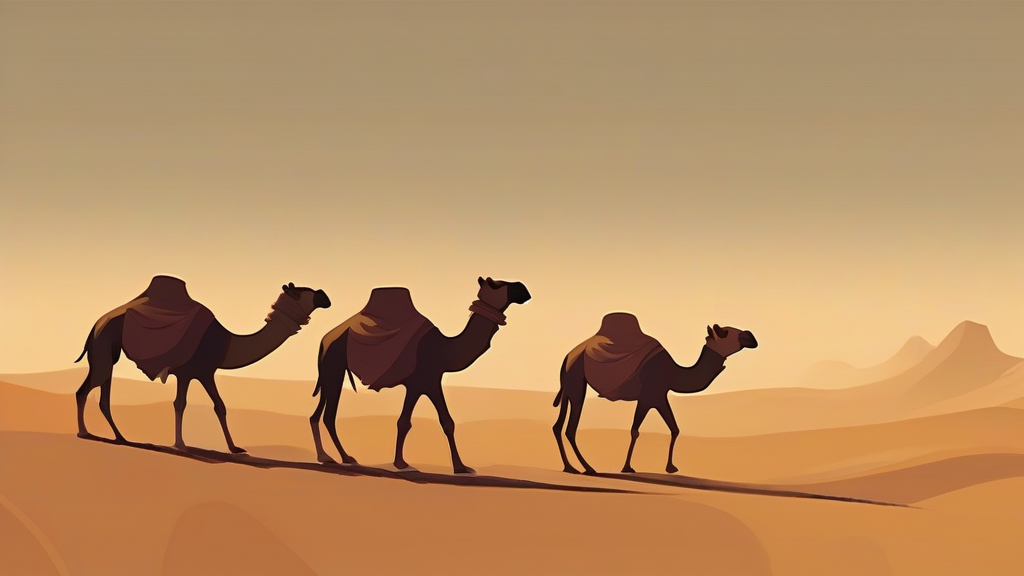
What does camel mean?
A camel is a large, long-legged desert mammal of the genus Camelus, famous for the fatty hump (or humps) on its back and its remarkable ability to survive long periods without drinking. Two species exist: the one-humped dromedary of Arabia and North Africa, and the two-humped Bactrian camel of Central Asia. For thousands of years camels have served humans as pack animals, sources of milk and meat, providers of wool and leather, and mounts for caravans crossing arid regions, earning the nickname 'ship of the desert.' Beyond the animal itself, the word names a light yellowish-brown color popular in fashion and interior design, and it appears in everyday idioms such as 'the straw that broke the camel's back,' which describes a final small burden that makes an already heavy load unbearable. Derived terms like camelCase, the programming convention of writing compound names with internal capitals, show how deeply the word has entered modern vocabulary.
A large, humped, long-necked desert mammal of the genus Camelus, kept since antiquity as a beast of burden and a source of milk, meat, and wool.
"Each camel in the caravan carried nearly two hundred pounds of trade goods."
Without further qualification, the word typically means the one-humped dromedary; the two-humped species is called the Bactrian camel.
A light yellowish-brown color, resembling the coat of a camel.
"He wore a camel overcoat over a dark sweater."
Standard plural; 'camel' can also function as a mass noun when referring to the meat or fabric made from the animal.
"Wild camels still roam parts of the Australian outback, descendants of animals imported during the nineteenth century."
A camel's hump doesn't hold water at all — it stores fat, which the animal can convert into both energy and metabolic water.
Reviewed by Deb Chak, Editor. AI-assisted content curated by RJS Tech Solutions LLP.
Etymology of camel
English borrowed 'camel' from Latin 'camelus', which in turn came from Greek 'kamēlos'; both were ultimately adapted from a Semitic source related to Hebrew 'gāmāl' and Arabic 'jamal'. The word entered Old English by way of Latin and was reinforced after the Norman period through Old French forms such as 'chameil'. Related borrowings include 'camelopard', an old name for the giraffe built on the same Greek element, and 'camlet', a fabric once made from camel hair.
Related word forms
How camel is actually used
In everyday speech, 'camel' usually refers specifically to the one-humped Arabian or dromedary camel unless otherwise stated; the two-humped species is normally called the Bactrian camel. The word is neutral in register and carries no strong connotations, though it appears in many idioms about endurance and overload.
Easily confused with camel
Caramel is a burnt-sugar confection or its brown color, while camel is the desert animal — the two are sometimes mixed up in speech because 'caramel' can be pronounced to sound similar.