What does cancan mean?
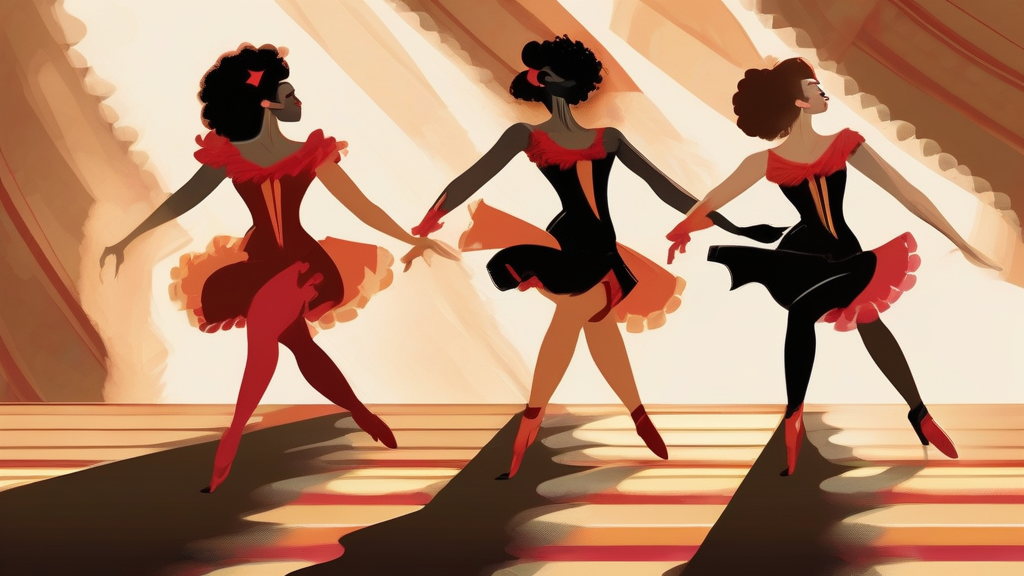
The cancan is a spirited stage dance of French origin, instantly recognizable for its high kicks, splits, and swirling skirts. Performed by lines of female dancers in frilled petticoats and black stockings, it emerged in working-class Parisian ballrooms in the early nineteenth century before being tamed and immortalized on cabaret stages such as the Moulin Rouge, which opened in 1889. The word also refers to the brisk, galop-like music that accompanies the dance, most famously Offenbach's Infernal Galop from Orpheus in the Underworld. Though once considered shockingly immodest enough to attract official censure, the cancan today connotes exuberance, spectacle, and nostalgic glamour rather than scandal. It remains a staple of revues in Paris and beyond, and the phrase 'to dance the cancan' is firmly embedded in English, making the word useful in discussions of theatre, dance history, and popular culture.
nounA lively, high-kicking French dance performed by a line of dancers in long skirts and petticoats, traditionally ending a music-hall or cabaret show.
- The energetic high-kicking French stage dance performed by women in frilled skirts and black stockings, popularized at Parisian cabarets such as the Moulin Rouge.
- (Less common) The music, typically fast-paced galop-style, written to accompany this dance.
"The cabaret closed its evening with a rousing cancan that brought the audience to its feet."
"The troupe's finale featured a whirlwind cancan, skirts flying as the dancers kicked in unison."
"Offenbach's galop, forever linked with the cancan, sent the orchestra into a breathless sprint."
The plural refers to multiple performances or renditions of the dance, or occasionally to the accompanying musical pieces.
"The evening's program included three different cancans by rival troupes."
The cancan was so scandalous in 19th-century Paris that police were once stationed in theatres to keep an eye on it — yet today it's the wholesome symbol of French cabaret worldwide.
Reviewed by Deb Chak, Editor. AI-assisted content curated by RJS Tech Solutions LLP.
Etymology of cancan
The word 'cancan' comes directly from French, where it originated in the early nineteenth century alongside the dance itself in the working-class dance halls of Paris. Its deeper origin is uncertain: some sources connect it to a French colloquial sense meaning 'noise' or 'scandal,' while others link it to 'quanquan,' an old term associated with quacking sounds, suggesting the name may have been playfully descriptive of the commotion the dance caused. English borrowed the word in the mid-nineteenth century, first in the hyphenated form 'can-can.' Related French words include 'chanson' (song) and 'caquet' (chatter), reflecting the same tradition of lively, noisy expression.
How cancan is actually used
Usually written without a hyphen in modern usage, though the hyphenated 'can-can' is still seen. The word carries connotations of theatricality, exuberance, and a touch of risqué history; it is almost exclusively used in contexts relating to cabaret, music hall, or dance history.
Easily confused with cancan
Can-can is simply an older hyphenated spelling of the same word; both refer to the identical French dance.
Concon is not an established English word, so the confusion is purely visual with the similar consonant pattern.