What does cannonading mean?
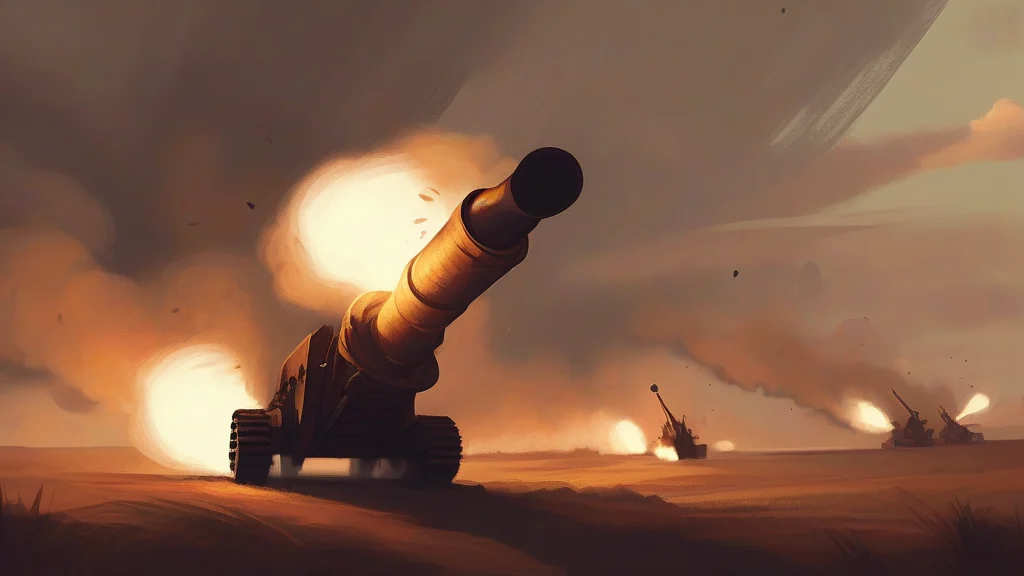
Cannonading refers to continuous, heavy firing of cannons or other heavy artillery against a target, typically sustained over a considerable period. The word functions both as a noun describing the roar of ongoing bombardment and as a verbal noun derived from the verb cannonade, meaning to attack with such fire. Historically associated with siege warfare and pitched battles of the seventeenth through nineteenth centuries, it evokes scenes of smoke-shrouded fortifications and armies enduring hour upon hour of thunderous shelling. In modern usage cannonading is largely literary or historical in flavor, appearing in war memoirs, histories, and figurative contexts where any relentless pounding — even a barrage of questions or criticism — is likened to artillery fire. Its synonyms include bombardment, shelling, and barrage, though none carries quite the same vivid, archaic resonance. The term ultimately traces back through French and Italian to the Latin canna, 'reed' or 'tube', the same root that gave us the word cannon itself.
Sustained, continuous firing of cannons or heavy artillery at a target.
"The garrison surrendered after three days of merciless cannonading."
Mostly encountered in historical and literary writing about warfare before the twentieth century.
As the present participle of the verb cannonade: the act of attacking a place with continuous cannon fire.
"Enemy ships were cannonading the coastal town from beyond the harbor's reach."
In this form the word functions as the progressive aspect of the verb cannonade.
Before modern warfare coined 'bombardment', writers reached for 'cannonading' — a word whose ultimate ancestor is the Latin canna, meaning 'reed', because early gun barrels were essentially metal tubes.
Reviewed by Deb Chak, Editor. AI-assisted content curated by RJS Tech Solutions LLP.
Etymology of cannonading
Cannonading comes from the verb cannonade, which English adopted in the early seventeenth century from French canonade, derived from canon ('cannon'). The French term traces further back to Italian cannone, meaning 'large tube', formed by augmenting canna ('tube, reed'), which descends from Latin canna, itself borrowed from Greek kannē. Cognates sharing this tube-and-reed lineage include canal, channel, and canyon, all ultimately rooted in the idea of a hollow cylinder. Cannonading thus preserves in its sound and sense the image of great metal tubes pouring out sustained fire.
Related word forms
How cannonading is actually used
Cannonading is chiefly historical and literary in register today, appearing mostly in accounts of battles from the age of smoothbore and early rifled artillery (roughly the 17th to 19th centuries). It carries a connotation of prolonged, deafening intensity rather than a single shot, and it is often used figuratively to describe any relentless pounding, whether literal gunfire or metaphorical bombardment such as a barrage of criticism. As a verbal noun it derives from the verb cannonade.
Easily confused with cannonading
A cannonball is the projectile fired from a cannon, whereas cannonading refers to the continuous act of firing cannons.
Canon is an established rule, list of works, or church law, while cannonading relates to artillery fire — the two are unrelated despite the similar spelling.