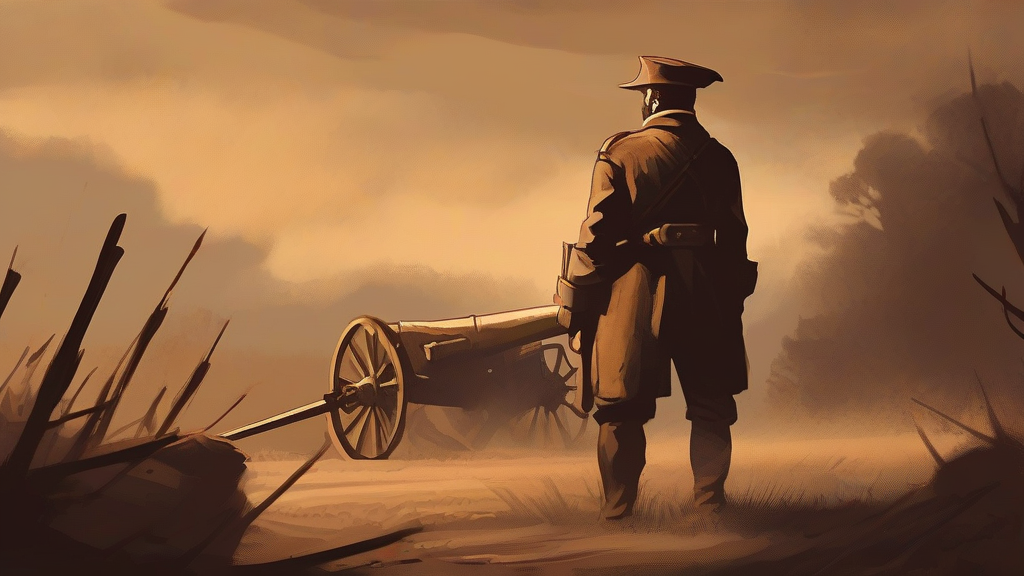
What does cannoneer mean?
A cannoneer is a soldier whose duty is to operate a cannon or other large artillery piece — loading, aiming, firing, and maintaining the weapon as part of a gun crew. The term dates from an era when cannons were the dominant arm of the battlefield, and each gun required a trained team to serve it effectively. Today the word survives chiefly in military history, museum interpretation, and Civil War or Napoleonic reenactments, where it lends authenticity to descriptions of past warfare. It also retains official standing in some armies: the United States Army, for instance, uses 'cannoneer' for enlisted artillery specialists and awards a cannoneer's badge bearing crossed cannons, one of its oldest branch insignia. While largely displaced by modern terms such as artilleryman or gunner, cannoneer endures as a precise and evocative label for those who worked the great guns of earlier centuries.
nounA soldier who operates, loads, or serves a cannon or other large artillery piece; a member of an artillery crew.
- A soldier who serves or operates a cannon or other heavy artillery piece.
- More broadly, any member of an artillery gun crew.
"The veteran cannoneer swabbed the bore and sighted the gun across the ridge."
"During the Civil War reenactment, a costumed cannoneer demonstrated how a six-pounder was loaded and fired."
"He enlisted at sixteen and spent the war as a cannoneer in the field artillery."
Regular plural; used when referring to multiple members of artillery crews, e.g. of a battery.
"The battery's cannoneers drilled daily until each gun could be served with speed and precision."
In the U.S. Army, the cannoneer's crossed-cannon insignia is one of the oldest branch badges still in use — artillerymen have worn it since the 1830s.
Reviewed by Deb Chak, Editor. AI-assisted content curated by RJS Tech Solutions LLP.
Etymology of cannoneer
Cannoneer derives from 'cannon', which entered English in the late Middle Ages, borrowed ultimately through French and Italian from Latin 'canna' meaning 'reed' or 'tube' — the hollow barrel suggesting a tube. The agent suffix '-eer' (from French '-ier') was added to form a term for the person who served the weapon, with the word established in English by the early 17th century. It thus shares its ultimate root with related formations such as cannonade and cannonball.
How cannoneer is actually used
Most often encountered in historical, military-historical, or reenactment contexts describing pre-20th-century warfare; modern usage favors terms like 'artilleryman' or 'gunner'. The word carries a somewhat archaic, period flavor. In U.S. military tradition it remains an official term for enlisted artillery specialists.