
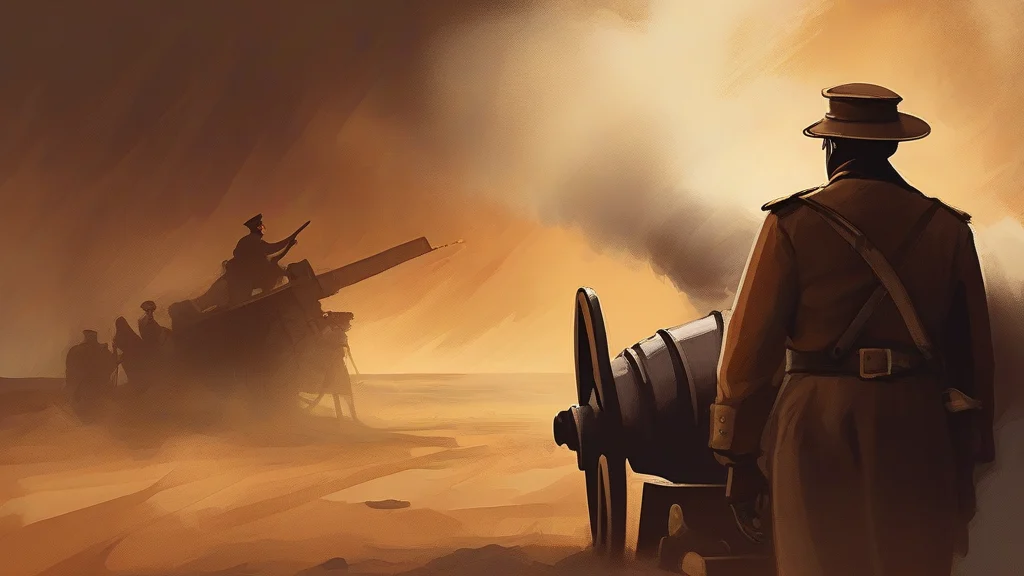
What does cannonier mean?
A cannonier is a soldier whose duty is to operate and fire a cannon — essentially an artilleryman of the pre-modern era. The term appears most often in historical and military writing describing the crews that manned smoothbore guns aboard warships and on land battlefields from roughly the sixteenth through the nineteenth centuries. Serving as a cannonier demanded physical strength, discipline, and technical skill: crew members had to load heavy shot and powder charges, aim the piece, and fire it in coordinated sequence, often under enemy fire. In modern English the word survives mainly in historical contexts, and it competes with the more common variant 'cannoneer.' Though rare today, it remains useful in historical fiction, wargaming, and museum interpretation to evoke the specialized trade of the gun-crew soldier.
nounA soldier who operates or fires a cannon; an artilleryman.
- A soldier who serves, loads, and fires a cannon; an artillery crew member.
"The experienced cannonier adjusted the elevation of the gun before giving the order to fire."
"The young cannonier swabbed the barrel before ramming home the next charge."
"A skilled cannonier could fire two aimed rounds per minute under ideal conditions."
Regular plural formation; used when referring collectively to the members of a gun crew.
"The fort's cannoniers worked in shifts to keep the batteries supplied with shot."
Before mechanized warfare, being a good cannonier was as much chemistry as courage — getting the powder charge right could be the difference between hitting the enemy and blowing up your own gun.
Reviewed by Deb Chak, Editor. AI-assisted content curated by RJS Tech Solutions LLP.
Where does cannonier come from?
Cannonier derives from 'cannon,' a word adopted into English from French in the late Middle Ages, ultimately of uncertain earlier origin — possibly related to Latin 'canna,' meaning reed or tube, via Italian 'cannone' (large tube). The suffix '-ier' reflects French agentive formation ('one who deals with'), giving 'one who serves a cannon.' English also formed the parallel variant 'cannoneer' with the Dutch-derived '-eer' suffix, which has become the dominant form, especially in American English.
Related word forms
How cannonier is actually used
A somewhat historical and relatively rare term, most at home in military-history writing and accounts of the age of sail and muzzle-loading artillery. The spelling 'cannoneer' is considerably more common in American usage.
Easily confused with cannonier
Cannoneer is the more common variant spelling for the same meaning; 'cannonier' is chiefly British and rarer.
A cannonade is a continuous burst of cannon fire, not the person firing it.