What does cantharid mean?
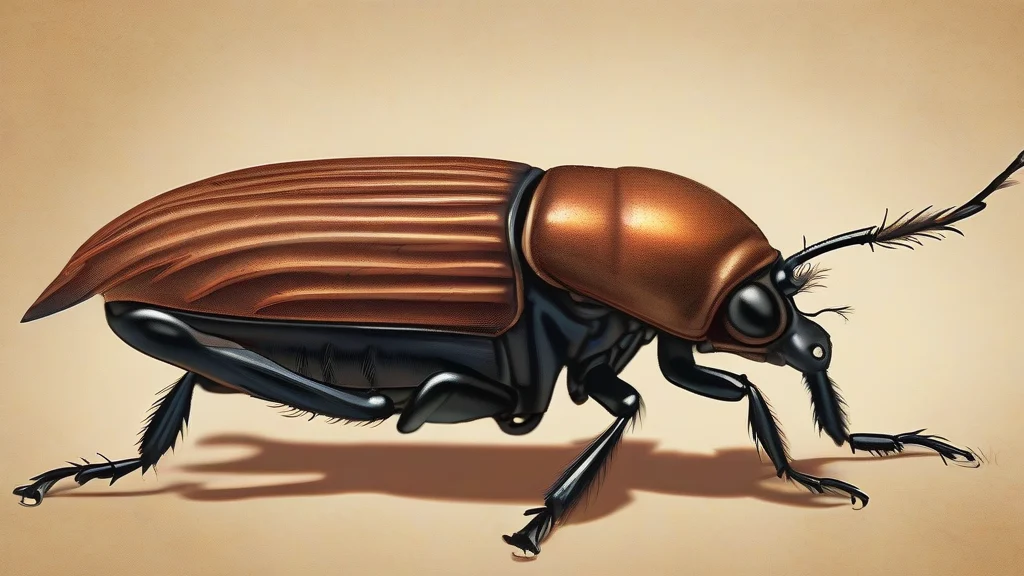
The cantharid is a blister beetle, most famously Lytta vesicatoria — the insect popularly known as 'Spanish fly'. Its body contains cantharidin, a potent irritant that raises blisters on contact with skin, which made dried cantharids a staple of pharmacy for centuries: physicians used them as counter-irritants to treat ailments ranging from gout to urinary complaints, while folk tradition cast them, misleadingly and dangerously, as an aphrodisiac. The word derives ultimately from the Greek kantharis, meaning a glow-worm or similar insect, passing through Latin before entering English usage in early modern medical writing. Today the term survives chiefly in entomological, toxicological, and historical contexts rather than ordinary conversation, and the familiar name 'Spanish fly' has largely displaced it. The cantharid remains memorable chiefly for its curious double reputation — legitimate medicine on one hand, notorious legend on the other.
nounA blister beetle, especially the species Lytta vesicatoria (the 'Spanish fly'), whose dried bodies were historically used medicinally as a counter-irritant and wrongly reputed to be an aphrodisiac.
- A blister beetle, particularly Lytta vesicatoria (Spanish fly), used historically in medicine as a counter-irritant.
- A preparation derived from such beetles, formerly applied to raise blisters on the skin.
"The apothecary's drawer still held a jar of powdered cantharid, its label faded beyond reading."
"Ancient physicians prescribed preparations of cantharid to draw inflammation to the surface of the skin."
"Collectors at the insect fair displayed a pinned specimen of the iridescent green cantharid."
The anglicized plural 'cantharids' is standard in modern entomology; the Latinate 'cantharides' appears in older medical and pharmaceutical texts.
"Old formularies list cantharides among their vesicants, while modern catalogues simply record cantharids."
The cantharid — better known as 'Spanish fly' — has been prized, feared, and abused as an aphrodisiac for over two thousand years, even though it is really just a poison that blisters skin.
Reviewed by Deb Chak, Editor. AI-assisted content curated by RJS Tech Solutions LLP.
Etymology of cantharid
The word cantharid comes from the Greek kantharis, an ancient term for a glowing insect, which Latin borrowed as cantharis to denote the blister beetle. European medical writers adopted the Latin form, and English texts from around the sixteenth and seventeenth centuries onward refer to cantharides — the plural inherited directly from Latin — in recipes for plasters and tinctures. The singular form cantharid emerged alongside this learned vocabulary, and the same root later gave chemistry the derivative cantharidin, named after the active principle isolated from the beetle.
How cantharid is actually used
Formal and largely historical in register; encountered mainly in entomology, pharmacology, and accounts of pre-modern medicine. In everyday contexts the term 'Spanish fly' is far more familiar than 'cantharid'. The plural 'cantharides' reflects the word's classical Latin heritage.
Easily confused with cantharid
Cantharidin is the toxic crystalline compound extracted from the cantharid beetle, not the beetle itself.