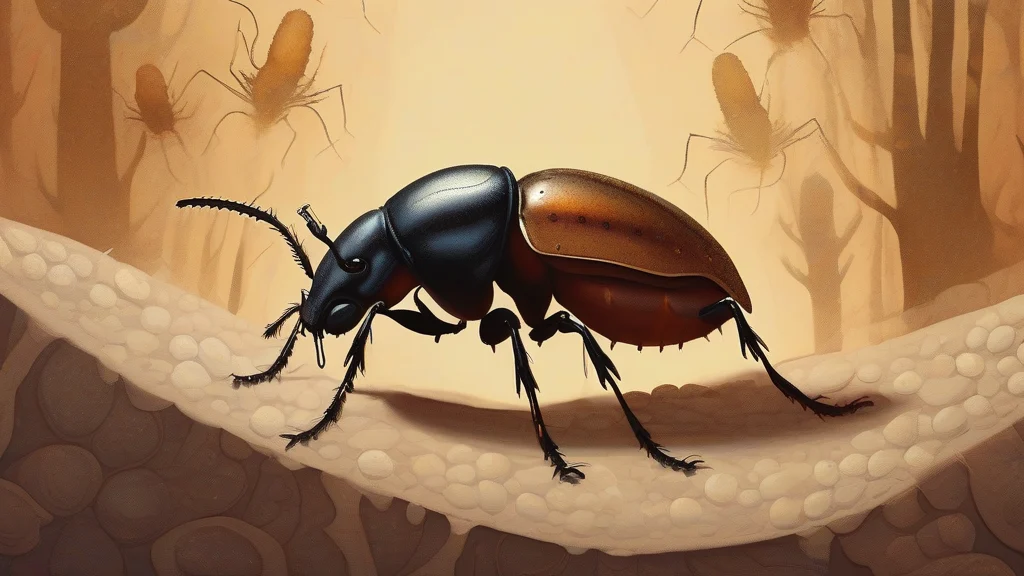
What does cantharidin mean?
Cantharidin is a potent, bitter-tasting poison produced naturally by certain beetles of the family Meloidae, most famously the Spanish fly (Lytta vesicatoria). Chemically classified as a terpenoid anhydride, it acts as a powerful vesicant — meaning it raises blisters wherever it touches the skin or mucous membranes — and it can be fatal if ingested in sufficient quantity. Because of these properties, cantharidin was long used in traditional medicine as a blistering agent, a diuretic, and an infamous (and dangerous) supposed aphrodisiac sold under the name 'Spanish fly'. Today its legitimate medical role is narrow: diluted formulations are applied by dermatologists to painlessly lift off warts and molluscum lesions, especially in children. The term belongs mainly to scientific and clinical registers, and its connotations are decidedly hazardous rather than benign.
nounA bitter, crystalline poisonous compound obtained from blister beetles (notably the Spanish fly, Lytta vesicatoria), which raises blisters on the skin and has been used historically in medicine and in wart removal preparations.
- A vesicant (blister-producing) toxic compound, C10H12O4, found in the body fluids of meloid beetles such as the Spanish fly.
- A pharmaceutical substance formerly administered as a diuretic and stimulant, and still used topically by dermatologists to treat warts and molluscum.
"The dermatologist applied a small amount of cantharidin to remove the patient's wart."
"Cantharidin causes severe blistering when it comes into contact with the skin."
"Historically, physicians prescribed cantharidin as a counter-irritant despite its narrow margin of safety."
Rarely used; cantharidin is normally treated as an uncountable mass noun since it denotes a single specific chemical compound.
"Trace levels of various cantharidins were detected in the herbal remedy."
The notorious aphrodisiac known as 'Spanish fly' owes its dangerous reputation entirely to this single compound — one that burns skin and can be lethal if swallowed.
Reviewed by Deb Chak, Editor. AI-assisted content curated by RJS Tech Solutions LLP.
Etymology of cantharidin
The word derives ultimately from the Greek kantharis (κανθαρίς), meaning a blister beetle or insect, which passed into Latin as cantharis. The compound name was formed in modern scientific Latin by adding the chemical suffix '-in', following the nineteenth-century convention of naming isolated organic substances. Related terms include cantharides, denoting the dried beetles themselves, and cantharism, referring to poisoning by them.
How cantharidin is actually used
A technical term confined chiefly to chemistry, medicine, pharmacology, and veterinary contexts; rarely encountered in everyday speech. It carries strongly negative connotations because of its toxicity.
Easily confused with cantharidin
Cantharides refers collectively to the dried bodies of blister beetles used as a drug source, whereas cantharidin is the specific toxic compound extracted from them.