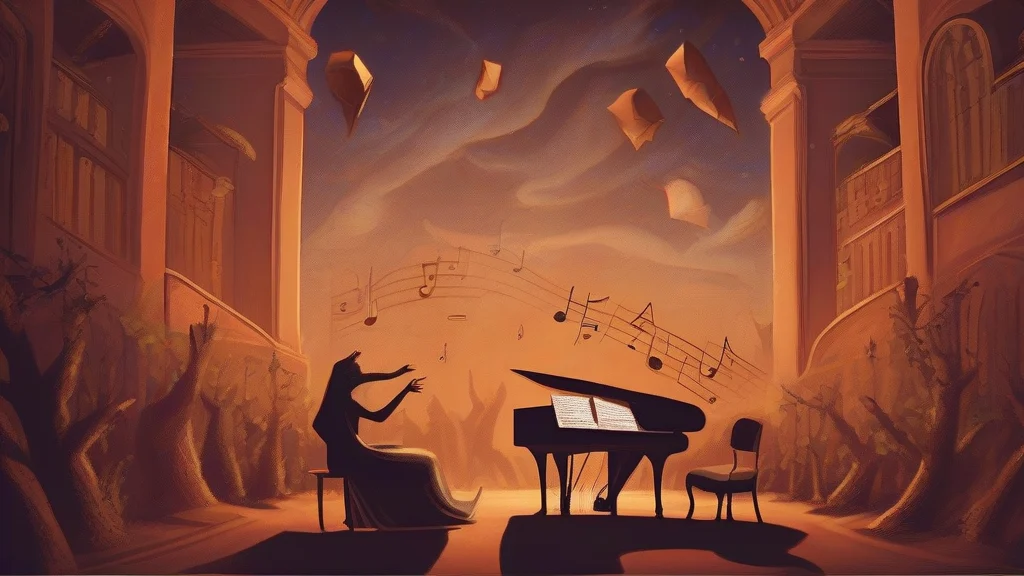
What does capriccioso mean?
Capriccioso is an Italian word adopted into English almost exclusively through music, where it functions as a performance direction meaning 'in a lively, free, and whimsical manner'. When a score is marked capriccioso, the performer is invited to play with playful spontaneity — leaning into sudden shifts of mood, tempo flexibility, and light-hearted unpredictability rather than strict metrical regularity. It often appears combined with a tempo indication, as in Allegro capricioso, signalling a fast movement handled with impish freedom. The word derives ultimately from the same Italian root as 'caprice', reflecting the idea of a sudden whim. Beyond the concert hall, capriccioso appears only rarely in English prose, where the more familiar adjective 'capricious' serves the same expressive purpose. For musicians and lovers of musical terminology, however, it remains a vivid shorthand for controlled mischief at the instrument — order and whim held in delightful tension.
adverbAs a musical direction, in a lively, free, and whimsical manner; performed with playful unpredictability. More generally, in a capricious or fanciful style.
- (Music) As a direction: to be played in a lively, free, whimsical manner.
- In a capricious, fanciful, or unpredictable manner.
"The pianist took the finale capriccioso, letting the melody dart playfully between registers."
"The violinist rendered the scherzo capriccioso, teasing each phrase before letting it fly."
"She decorated the garden capriccioso, mixing formal hedges with riotous bursts of wildflowers."
When a composer writes capriccioso over a score, they're literally instructing the musician to misbehave — beautifully.
Reviewed by Deb Chak, Editor. AI-assisted content curated by RJS Tech Solutions LLP.
Etymology of capriccioso
Capriccioso comes directly from Italian, where it means 'capricious' or 'whimsical'; it entered English usage in the eighteenth century along with the wider wave of Italian musical terminology that gave English terms like allegro, dolce, and scherzando. The Italian word traces back to 'capriccio', meaning a sudden whim or shiver of fancy, whose deeper origins are debated but often linked to the Latin 'capreolus' or the notion of a goat's sudden start ('capra', goat). Its closest English relatives are the nouns 'caprice' and 'capriccio' and the adjective 'capricious', all borrowed through the same Italian channel.
How capriccioso is actually used
Capriccioso is primarily a term from musical notation, where it appears as an Italian performance direction alongside tempo markings (e.g., 'Allegro capriccioso'). Outside music it is rare and carries a distinctly literary or affected tone; writers usually prefer the native adjective 'capricious' instead. It is invariable — it does not inflect for gender or number in borrowed English usage.
Easily confused with capriccioso
A capriccio is a noun denoting a lively, freewheeling musical composition, while capriccioso is an adverb describing how a piece should be played.
Capricious is an English adjective describing unpredictable changeability of mood or behaviour, whereas capriccioso is an Italian-derived adverb used chiefly as a musical direction.