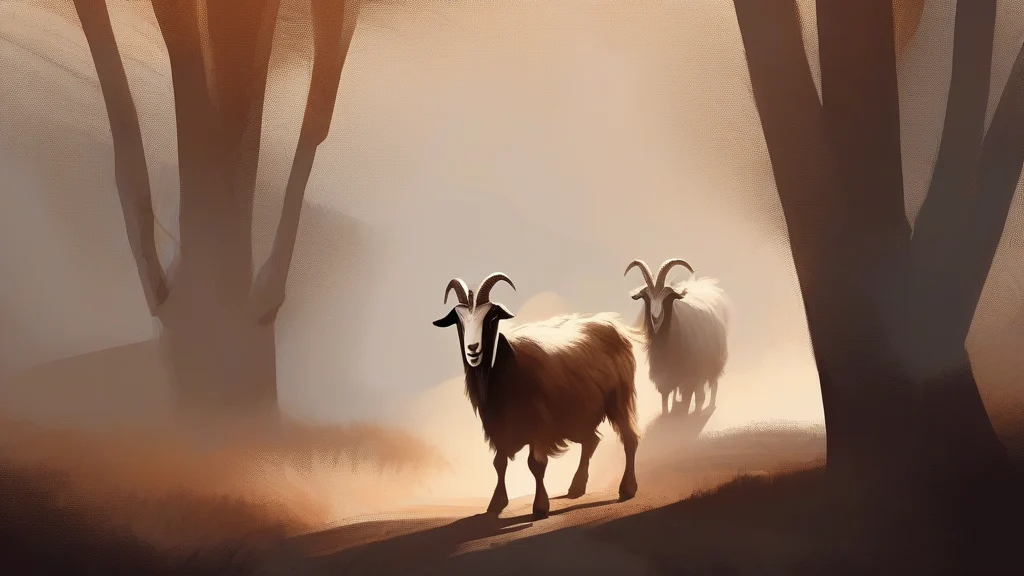
What does caprine mean?
Caprine is an adjective meaning of or relating to goats. It belongs to a small family of technical terms that pair animals with their Latin roots, alongside bovine for cattle, ovine for sheep, and equine for horses. In practice, caprine appears most often in scientific, agricultural, and veterinary writing — caprine breeds, caprine milk, caprine health — where precision matters and 'goat' alone would seem imprecise. A second, more literary sense describes things that resemble or suggest a goat, whether that is a nimble leap up a rocky slope, a stubborn streak of temperament, or even a neatly trimmed beard on an otherwise human face. The word derives from the Latin caper, meaning goat, which also gave rise to 'capricious,' making it a pleasing example of how one animal's name can echo through English in unexpected ways.
adjectiveOf, relating to, or characteristic of goats.
- Of or relating to goats, especially in scientific, agricultural, or veterinary contexts.
- Resembling or suggestive of a goat in character, such as agility, stubbornness, or goatee-like features.
"The farm's caprine residents clambered over the stone walls with effortless agility."
"The veterinary journal published a study on caprine nutrition in arid climates."
"He gave her a caprine grin, complete with a scruffy little beard."
From the same Latin root for 'goat' comes both 'caprine' and 'capricious' — ancient Romans apparently blamed goats for erratic behavior long before we did.
Reviewed by Deb Chak, Editor. AI-assisted content curated by RJS Tech Solutions LLP.
Etymology of caprine
Caprine comes from the Latin caprinus, an adjective formed from caper, the Latin word for a he-goat. The term passed into English during the early modern period as part of the wave of Latinate vocabulary adopted into scholarly and naturalist writing. It shares its ultimate root with other goat-derived words such as 'capriole,' the leaping movement in dressage, and 'cabriole,' the furniture leg and ballet jump named for the animal's springing gait; 'capricious' likewise traces back through Italian to the same Latin source.
Related word forms
How caprine is actually used
Primarily a formal or technical term used in zoology, agriculture, and veterinary medicine; its figurative use to describe goat-like mannerisms or appearance is rarer but attested in literary prose.
Easily confused with caprine
Bovine relates to cattle and oxen, whereas caprine relates specifically to goats.
Ovine refers to sheep, while caprine refers to goats.