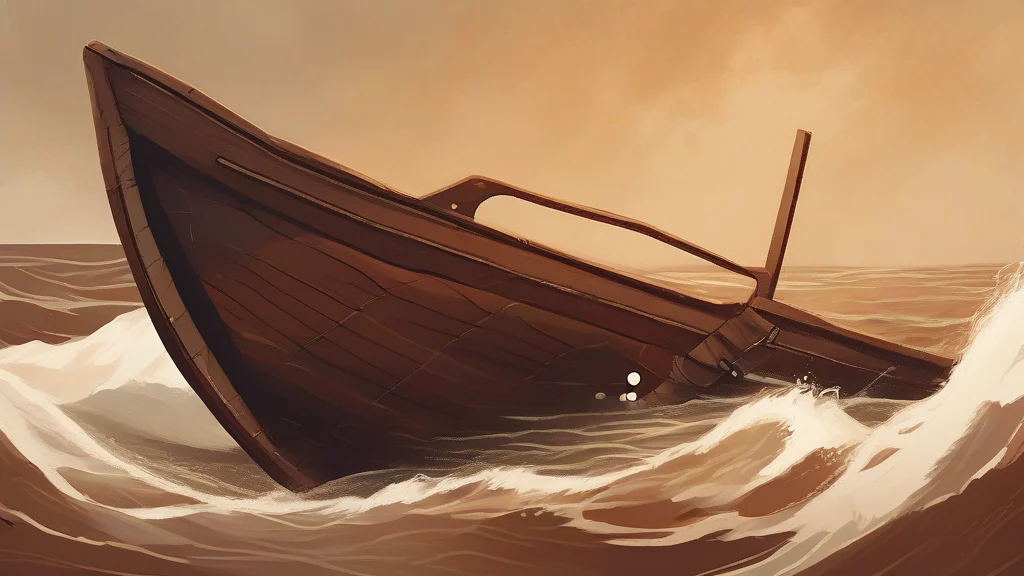
What does capsize mean?
To capsize is to overturn — specifically said of boats and other watercraft that flip over or roll upside down in the water. A canoe may capsize when its occupants shift their weight too sharply, and a larger vessel may capsize in a storm when waves or wind overwhelm its stability. The word works both ways: a boat 'capsizes' on its own, or something 'capsizes' it. It belongs firmly to the vocabulary of the sea and inland waterways, carrying connotations of sudden danger and emergency, since capsizing frequently threatens lives and cargo. The term dates to the late eighteenth century and remains the standard, neutral way to describe such accidents in news reports, safety manuals, and sailing instruction. Its vividness comes from its precision — where 'sink' suggests going under entirely, capsize describes the dramatic moment a hull loses its upright footing and rolls over, even if it later floats or is righted.
verb(Of a boat or other vessel) to overturn in the water; to fill with water and turn upside down.
- (intransitive) Of a boat or vessel, to overturn or be overturned in the water.
- (transitive) To cause a boat or vessel to overturn.
"A sudden squall caused the dinghy to capsize just off the shore."
"The ferry capsized in heavy seas, and all passengers were rescued by nearby fishing boats."
"One careless shift of cargo can capsize a small skiff in minutes."
'Turn turtle' was sailors' slang for a capsized ship — because once flipped, a hull really does sit there like an overturned turtle.
Reviewed by Deb Chak, Editor. AI-assisted content curated by RJS Tech Solutions LLP.
Etymology of capsize
Capsize entered English in the late eighteenth century as a nautical term. Its ultimate origin is debated: it has been linked to Spanish naval vocabulary (compare 'capuzar', to plunge or sink headfirst) and to Romany sources, but no single derivation is universally accepted by etymologists. Whatever its precise root, it became firmly established in maritime English for the overturning of vessels and has remained essentially unchanged in meaning since.
Related word forms
How capsize is actually used
Primarily used of boats and ships; figurative uses are rare. Both transitive and intransitive senses are standard, though the intransitive use ('the boat capsized') is far more common than the transitive ('waves capsized the boat').
Easily confused with capsize
A capsule is a small case or container (such as a pill), while capsize is a verb meaning a boat overturning in the water.