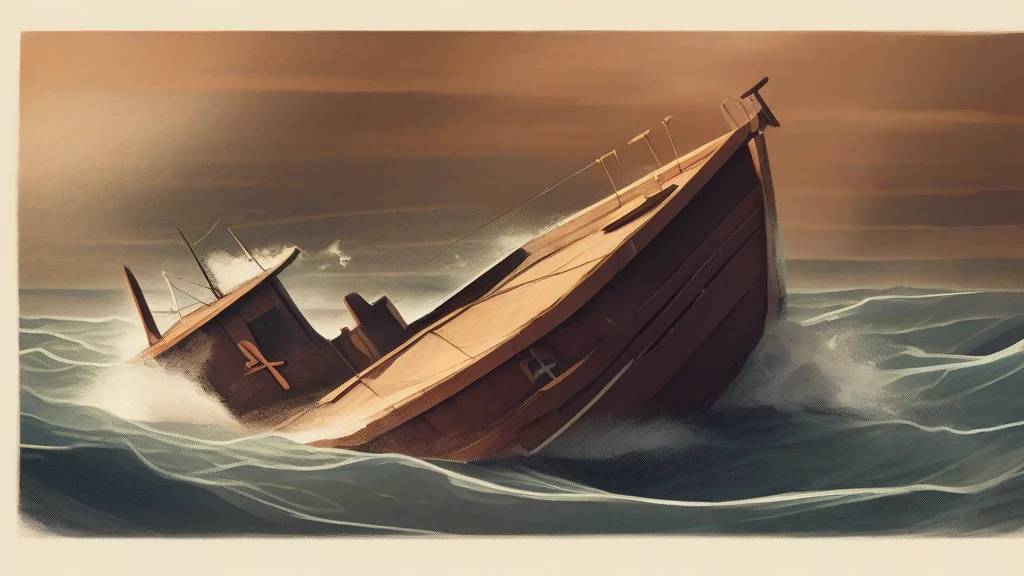
What does capsized mean?
"Capsized" is the past tense and past participle of the verb "capsize," meaning that a boat or ship has overturned in the water — turned onto its side or completely upside down, keel uppermost. The word belongs firmly to the maritime vocabulary and appears constantly in news reports of ferry accidents, sailing mishaps, and rescue operations: a canoe may capsize in calm water through carelessness, while a cargo ship may capsize in a storm. It also works naturally as an adjective before a noun, as in "a capsized dinghy" or "the capsized vessel." The tone of the word is serious rather than playful; it implies danger, emergency, and often loss. Its synonyms include "overturned," "flipped," and "upended," though these are broader terms not restricted to vessels. Interestingly, the parent verb "capsize" burst into English as nautical slang in the late eighteenth century, and its precise origins remain uncertain — a rare case of a common word whose ancestry dictionaries still mark as obscure.
Past tense and past participle of "capsize": (of a boat or ship) to overturn in the water, turning onto its side or keel-up.
"The overloaded ferry capsized within minutes of leaving port."
Almost always used of watercraft; using it for vehicles or land objects sounds unusual.
Describing a vessel that has overturned: 'a capsized rowboat'.
"Divers located the capsized wreck resting on the seabed."
"Capsize" appeared suddenly in nautical slang in the late 18th century — and its true origin is still a mystery lexicographers haven't fully solved.
Reviewed by Deb Chak, Editor. AI-assisted content curated by RJS Tech Solutions LLP.
Etymology of capsized
The verb "capsize" entered English in the late eighteenth century as nautical slang, first recorded around the 1780s–1790s, meaning to upset or overturn a ship. Its ultimate origin is uncertain: suggested sources include a possible link to Spanish nautical vocabulary or other sea-going jargon, but lexicographers have never established a definitive root, and major dictionaries label it "origin unknown." Because of this obscurity, there are no well-established cognates from a shared root; the word's family consists simply of its own derived forms, such as the gerund "capsizing."
Related word forms
How capsized is actually used
"Capsized" is standard in both British and American English and carries a serious, often urgent connotation — it frequently appears in news reporting about maritime accidents. It is slightly more formal than "flipped" or "turned over." As an attributive modifier it is common and fully accepted: "a capsized canoe."
Easily confused with capsized
"Overturned" is a general term for anything flipped upside down (vehicles, objects), while "capsized" applies specifically to boats and ships overturning in water.