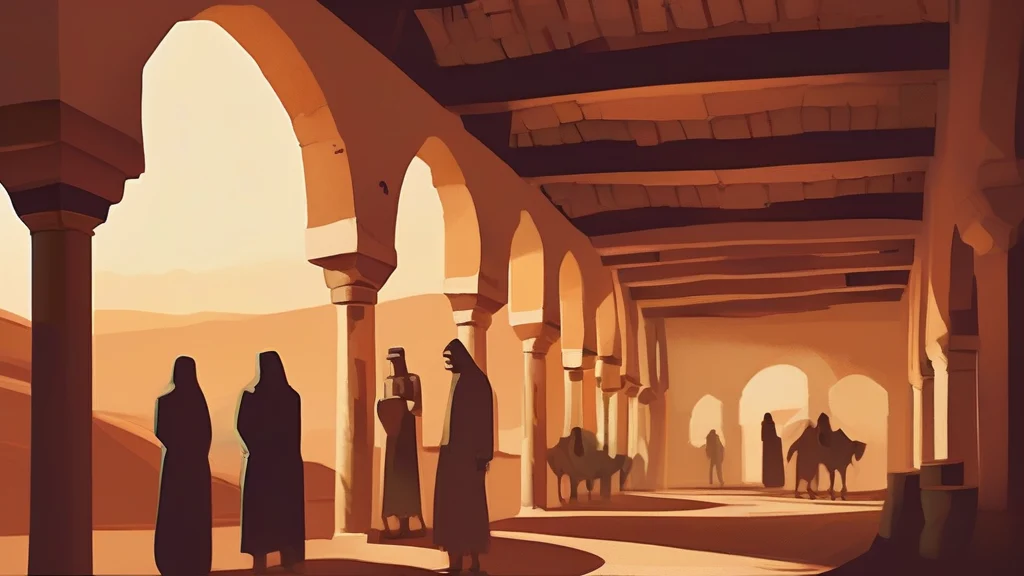
What does caravanserai mean?
A caravanserai is a large inn, typically built as a fortress-like structure around an open central courtyard, that provided lodging, food, and stabling for merchants and travelers journeying along the great trade routes of Asia, the Middle East, and North Africa — most famously the Silk Road. Usually endowed by sultans, merchants, or rulers as pious or civic works, these buildings allowed caravans to rest safely behind locked gates, often free of charge, before resuming long journeys across deserts and mountains. Thousands were constructed from antiquity through the Ottoman era, and many impressive ruins survive today across Iran, Turkey, and Central Asia. In modern usage the word carries rich historical and literary connotations of exotic trade routes, desert travel, and crossroads cultures; it appears mostly in history, architecture, and travel writing, sometimes extended metaphorically to any bustling way station or gathering place for travelers. Variant spellings include 'caravansary.' It derives ultimately from Persian 'karwān-sarāy,' meaning 'caravan palace.'
nounAn inn built around a large courtyard where caravans of travelers and merchants could rest overnight, especially along trade routes in the Middle East and Central Asia.
- A fortified inn with a central courtyard providing lodging for caravans and other travelers along Asian and North African trade routes.
- Any similar resting place or way station for travelers (extended or figurative use).
"The merchants unloaded their camels at the caravanserai and bartered for supplies before continuing east."
"Ruins of a twelfth-century caravanserai still stand beside the old Silk Road route through Anatolia."
"Her travel memoir describes the hotel as 'less a hotel than a modern caravanserai,' full of traders and wanderers from every direction."
Both plurals are accepted; 'caravanserais' follows the anglicized spelling while 'caravansaries' follows the French-derived spelling.
"Hundreds of crumbling caravanserais dot the ancient trade routes across Iran and Turkey."
Every night on the Silk Road, merchants paid nothing to sleep in these walled inns — but had to leave by sunrise, because the gates closed at dawn whether you were ready or not.
Reviewed by Deb Chak, Editor. AI-assisted content curated by RJS Tech Solutions LLP.
Etymology of caravanserai
Caravanserai comes from Persian 'karwān-sarāy,' a compound of 'karwān' (a company of travelers or caravan) and 'sarāy' (palace or large house), literally 'caravan palace.' The word entered European languages through Ottoman Turkish during the early modern period, first appearing in English in the early 17th century. A French-influenced variant, 'caravansary,' developed separately and remains standard alongside the original form. Related borrowings include 'caravan' itself and 'serai,' both from the same Persian roots.
How caravanserai is actually used
Register: literary to formal; rare in everyday conversation but common in historical, architectural, and travel writing. The variant spelling 'caravansary' (from French) is equally standard in American English. Plural forms include both 'caravanserais' and 'caravansaries'.
Easily confused with caravanserai
Caravansary is simply an English variant spelling (via French) of the same word with an identical meaning; neither is a different thing.
A caravan is a group of traveling merchants or their vehicles/animals, while a caravanserai is the building where such groups lodge.