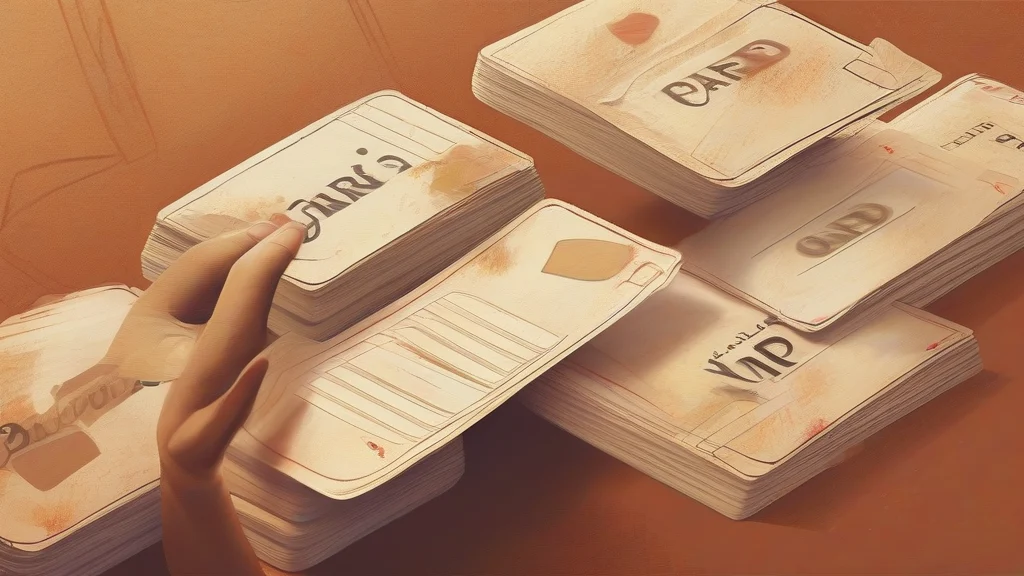
What does card mean?
A card is a thin, stiff rectangle of paper or plastic that carries information or enables some action — identifying its holder, authorizing a payment, conveying a greeting, or serving as a unit in a game. Few words are woven so deeply into everyday life: we carry business cards, bank with credit cards, remember appointments on index cards, and play games with decks of fifty-two. The noun also appears in fixed idioms such as "play your cards close to your chest," where cards metaphorically stand for secrets or strategies. As a verb, chiefly in American English, "to card" means to check someone's identification to confirm they are old enough to buy alcohol or enter a venue. Versatile, concrete, and endlessly combinable, "card" is a small word doing enormous work in modern vocabulary, and understanding it illuminates everything from commerce to leisure.
A small, flat, stiff piece of paper or plastic bearing information, used for identification, payment, greetings, games, or records.
"She slipped the invitation card into her bag before leaving."
Appears in numerous fixed compounds such as credit card, business card, and postcard.
One of a set of playing cards used in games and magic tricks.
"He shuffled the cards and dealt five to each player."
A greeting card sent to mark a birthday, holiday, or other occasion.
"Her grandmother still sends a handwritten birthday card every year."
To request proof of age by examining someone's identity document, typically before selling alcohol or admitting them to a venue.
"The bartender carded him even though he was clearly over thirty."
Informal and chiefly North American.
Standard plural. "Cards" can also refer collectively to a game played with playing cards (e.g. "an evening of cards").
"He collected vintage baseball cards from the 1960s."
The word on your credit card traces back over two thousand years to the Greek word for a strip of papyrus — meaning every time you swipe, you're handling a descendant of ancient paper.
Reviewed by Deb Chak, Editor. AI-assisted content curated by RJS Tech Solutions LLP.
Etymology of card
The word "card" entered English from Old French "carte" in the fifteenth century, originally referring to playing cards shortly after their arrival in Europe. It ultimately derives from Latin "charta," meaning a leaf of paper or papyrus, which itself comes from Greek "khartēs." The same Latin root gave English "chart," "charter," and "cartography," making "card" a cousin of these words. Its use expanded over the centuries from gaming to visiting cards, business cards, and eventually plastic credit and identity cards.
Related word forms
How card is actually used
The noun is neutral in register and extremely versatile, appearing in countless compounds. The verb "to card" is informal and chiefly North American, typically heard in bars and shops when staff verify that a customer is of legal age. In British English the phrase "play one's cards right" and similar idioms are common; the verb sense is less frequent there.
Easily confused with card
"Chard" is a leafy green vegetable, while "card" is a piece of stiff paper or plastic used for identification, payment, or games.