
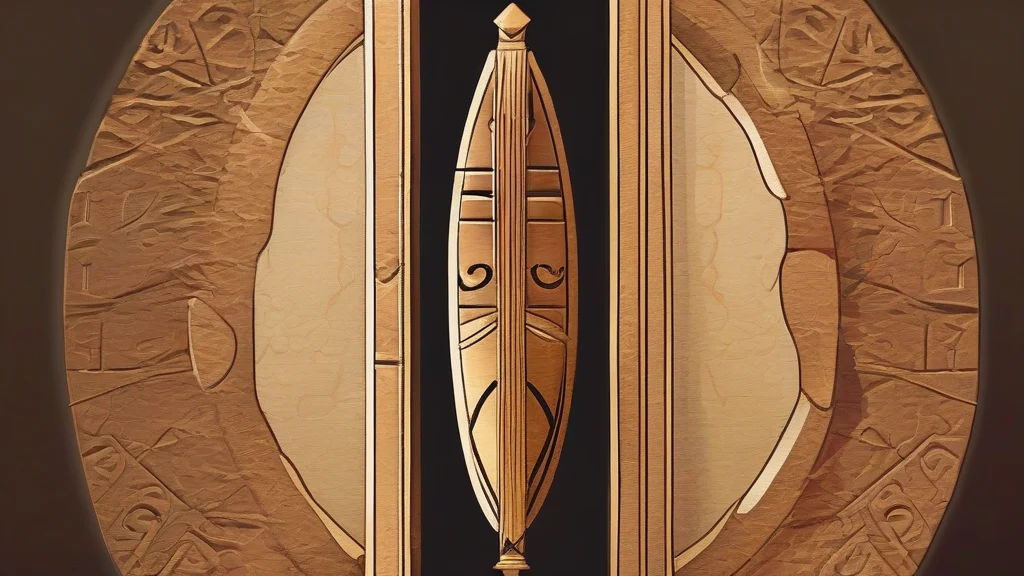
What does cartouche mean?
A cartouche is an elongated oval or oblong enclosure surrounding a group of Egyptian hieroglyphs, most famously used to set off the name of a king or queen. Because royal names appeared inside these distinctive outlines, the cartouche proved crucial to decipherment: Jean-François Champollion exploited the cartouches on the Rosetta Stone and other monuments to confirm the phonetic values of hieroglyphic signs. Beyond Egyptology, the term describes any ornamental frame — often scrollwork, shield-shaped, or tablet-like — used in architecture, painting, book design, and graphic decoration, particularly in Renaissance and Baroque work. The word entered English in the early seventeenth century from French, ultimately from Italian cartoccio, meaning a roll of paper, which also gives us 'cartoon' and 'carton'. Today 'cartouche' appears mainly in scholarly, museum, and art-historical contexts, lending writing an air of antiquarian precision.
An oval or oblong figure enclosing a group of Egyptian hieroglyphs representing a royal name.
"Every cartouche on the temple wall contained part of Ramesses II's throne name."
In this sense the word is almost exclusively Egyptological.
An ornamental frame, often scroll-shaped or tablet-like, used in architecture, painting, or graphic design.
"The map's title was lettered inside an elaborate cartouche in the lower corner."
Common in descriptions of antique maps, Baroque ornament, and heraldry.
Standard English plural; no alternative form is common.
"The frieze was crowded with cartouches bearing the names of forgotten officials."
Napoleon's soldiers coined the word: to them, the oval rings of hieroglyphs on Egyptian monuments looked like their own paper gun cartridges — and one soldier's bullet hole in that very 'cartridge' at Rosetta nearly destroyed the stone that unlocked ancient Egypt.
Reviewed by Deb Chak, Editor. AI-assisted content curated by RJS Tech Solutions LLP.
Etymology of cartouche
'Cartouche' comes from French cartouche, meaning a gun cartridge or rolled paper case, borrowed in the early seventeenth century. The French word derives from Italian cartoccio, a roll of paper, a diminutive formation on carta ('paper'), from Latin charta. When Napoleon's soldiers saw the oval hieroglyphic enclosures on Egyptian monuments during the 1798 campaign, they thought the shapes resembled their rifle cartridges, and the name transferred to the glyphs themselves. The same Italian root yields 'cartoon' and 'carton', making these true etymological cousins.
How cartouche is actually used
The word carries scholarly and art-historical register; it appears most often in discussions of Egyptology, archaeology, and decorative arts. The plural is usually anglicized as 'cartouches', though the French-style plural 'cartouches' with the same spelling is standard in English. It is not used casually.
Easily confused with cartouche
A cartridge is an ammunition casing or replaceable container (e.g., ink cartridge), whereas a cartouche is a decorative oval frame or hieroglyphic name-enclosure.