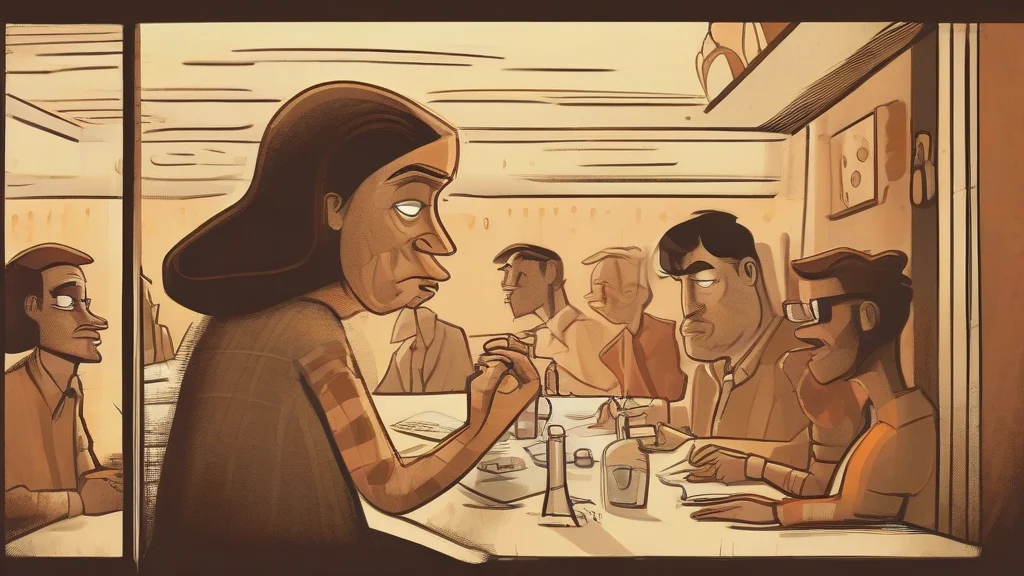
What does caricatured mean?
Caricatured is the past tense and past participle of the verb caricature, meaning to represent someone or something through deliberate exaggeration and distortion. In its literal sense, it describes portraits or drawings that amplify distinctive physical features for comic or satirical effect, a tradition associated with editorial cartooning and satirical illustration. More often today, it appears figuratively: politicians, movements, academic theories, and entire communities are said to be caricatured when they are reduced to a crude, simplified version of themselves — a portrayal so exaggerated that it becomes unfair or unrecognizable. The word typically carries a critical connotation, implying that the depiction trades accuracy for easy ridicule or convenience. Because it names both a visual art form and a habit of thought, caricatured is a useful word in discussions of media, debate, and representation, capturing precisely how exaggeration can shade into misrepresentation.
verb (past tense and past participle of 'caricature')Represented or described someone or something in an exaggerated, distorted way that reduces their essential features to a comical or grotesque simplification. Often used figuratively for unfair or oversimplified portrayals of people, groups, ideas, or positions.
- Drawn or depicted as a caricature: represented pictorially with exaggerated features for comic or satirical effect.
- Described or presented in an exaggerated, oversimplified way that distorts the truth of a person, idea, or position (often figurative).
"The editorial caricatured the senator's position until it bore little resemblance to what she had actually said."
"The magazine cover caricatured the prime minister with a nose twice its real length."
"Critics complained that the film had caricatured small-town life rather than depicting it honestly."
The word traces back to Italian 'caricare' — literally 'to load' — so a caricatured portrait is one 'loaded' with more than reality can bear.
Reviewed by Deb Chak, Editor. AI-assisted content curated by RJS Tech Solutions LLP.
Etymology of caricatured
Caricatured derives from the verb caricature, which English adopted in the late 17th century from the French 'caricature', itself borrowed from the Italian 'caricatura'. The Italian term comes from 'caricare', meaning 'to load or overload' — the same root that gives us 'charge', 'cargo', and ultimately the Latin 'carrus' (a wheeled vehicle). The original idea was that a caricature 'loads' a face with exaggerated features beyond what nature provides. Cognates across European languages, such as French 'caricaturer' and German 'karikieren', reflect the same Italian source.
Related word forms
How caricatured is actually used
Most frequent in journalistic, critical, and political commentary, where it carries a mildly negative connotation of unfairness or intellectual dishonesty. The passive ('was caricatured') is especially common when writers distance themselves from the distortion. In art-historical contexts it retains the neutral, technical sense of being rendered in caricature style.
Easily confused with caricatured
'Characterized' means described by distinguishing qualities, while 'caricatured' specifically means portrayed with exaggerated distortion.