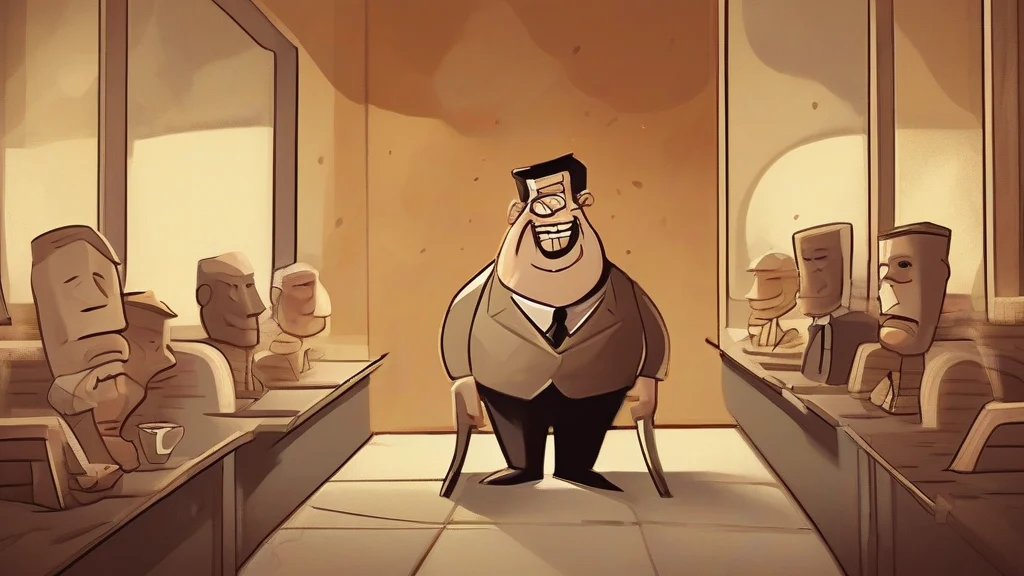
What does caricature mean?
A caricature is a representation of a person — whether a drawing, a written description, or an imitation — that deliberately exaggerates their most striking features to produce a comic or grotesque effect. The classic example is the portrait artist who enlarges a politician's nose or a celebrity's grin until the likeness is both recognisable and absurd. Beyond visual art, the word is widely used figuratively: a character in fiction, or even an idea or institution, can be dismissed as a caricature if it is portrayed so simplistically that it becomes a distorted parody of reality. The term derives from the Italian 'caricare', meaning 'to load' or 'to exaggerate', and entered English in the seventeenth century alongside the rise of satirical portraiture in Europe. Today it appears frequently in discussions of political cartoons, satire, and criticism, where calling something a caricature usually implies unfairness or lack of subtlety.
A picture, description, or imitation of a person in which certain striking characteristics are exaggerated in order to create a comic or grotesque effect; also, figuratively, a grossly distorted or simplified representation of something.
"Her memoir was criticised for reducing her colleagues to mere caricatures."
Often used figuratively in critical writing to imply an unfairly reductive portrayal.
To represent or imitate someone or something in an exaggerated or distorted way for comic effect.
"The sketch show caricatures world leaders with merciless affection."
Standard plural form; used both for multiple drawings/descriptions and figuratively for multiple distorted representations.
"The gallery's walls were lined with caricatures of nineteenth-century statesmen."
The word comes from Italian 'caricare' — 'to load' — because a caricature literally 'overloads' a face with its own most distinctive features.
Reviewed by Deb Chak, Editor. AI-assisted content curated by RJS Tech Solutions LLP.
Etymology of caricature
Caricature comes from the Italian 'caricatura', from 'caricare' meaning 'to load' or 'to exaggerate', itself derived from Latin 'carrus' (a wheeled vehicle). The term arose in late sixteenth-century Italy to describe portraits overloaded with a subject's distinguishing traits, and entered English in the early seventeenth century as satirical exaggerated portraiture spread across Europe. It shares its Latin root with words like 'cargo' and 'charge'.
Related word forms
How caricature is actually used
As a noun, 'caricature' is neutral in register but often carries a mildly negative connotation when used figuratively, suggesting an unfair or reductive portrayal. The figurative sense (e.g. 'a caricature of justice') is common in journalism and criticism.
Easily confused with caricature
A cartoon is a humorous drawing generally, while a caricature specifically exaggerates a subject's features for comic or grotesque effect.
'Charicature' is not a word — it is simply a common misspelling of caricature.