What does carrack mean?
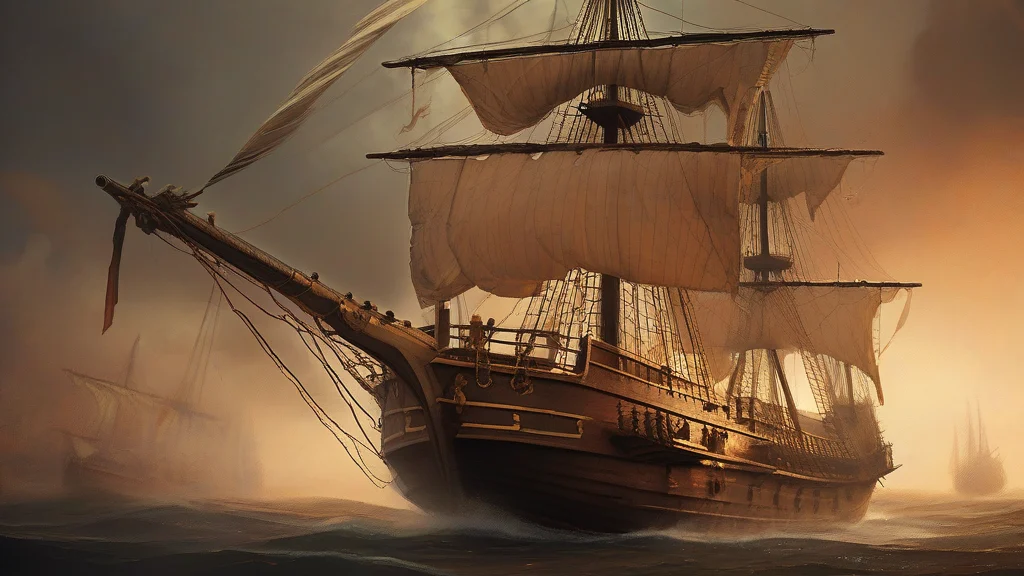
A carrack was a large European sailing ship that dominated seaborne commerce from roughly the 14th to the 17th centuries. Distinguishable by its high forecastle and aftcastle — giving it a distinctive, fortress-like silhouette — and usually rigged with three or four masts combining square and lateen sails, the carrack was built primarily as a cargo carrier rather than a fighting vessel. It was the ship type behind Portugal's spice voyages to India and Spain's treasure fleets across the Atlantic, capable of carrying enormous loads on long ocean passages. Though gradually superseded by the sleeker, better-armed galleon in the 16th century, the carrack remains central to maritime history and naval archaeology. The word appears today almost exclusively in historical writing, museum interpretation, and discussions of early modern seafaring.
nounA carrack is a large, three- or four-masted merchant ship used by European maritime powers from the 14th to the 17th centuries, typically with high bow and stern castles.
- A large European merchant sailing ship of the 14th–17th centuries, characterized by high fore- and sterncastles and typically three or four masts.
"The Portuguese carrack rode heavily at anchor in Lisbon harbor, its hold crammed with pepper from Malabar."
"The Spanish carrack made slow but steady progress across the Atlantic, laden with colonial goods."
"Museum reconstructions show how a 16th-century carrack towered over the smaller warships around it."
Standard plural; simply add -s.
"Several carracks were lost in the storm off the Azores."
Mary Rose and Vasco da Gama's fleet alike depended on the carrack — the boxy, castle-topped workhorse that carried Europe's first global trade empires.
Reviewed by Deb Chak, Editor. AI-assisted content curated by RJS Tech Solutions LLP.
Etymology of carrack
Carrack entered English in the 15th century, borrowed from French caraque, which itself derives from Spanish and Portuguese carraca. The ultimate origin is uncertain, though it is often connected to Arabic qarāqīr, a plural referring to small trading vessels. Cognate forms appear across Romance languages, reflecting how widely these ships were used in Mediterranean and Atlantic trade.
How carrack is actually used
Carrack is a historical term, now found mainly in maritime history, archaeology, and nautical literature rather than everyday speech. It is sometimes spelled carack in older sources.
Easily confused with carrack
Carack is simply an older variant spelling of the same word for a medieval cargo ship, not a different word.