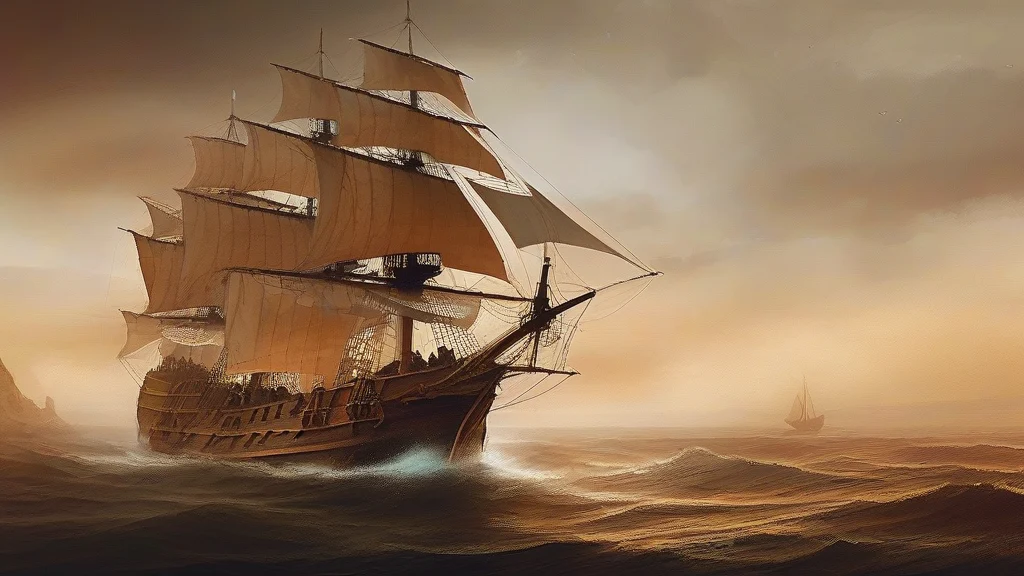
What does galleon mean?
A galleon is a large sailing ship developed in Europe during the 16th century and used through roughly the 18th century, most famously by Spain to carry goods and precious metals between its colonies and Europe. Characterized by multiple decks, a long raised stern, and substantial cargo capacity, galleons served both as merchantmen and warships, forming the backbone of transatlantic trade routes such as the Manila Galleon route linking Asia and the Americas. Today the word appears almost entirely in historical, archaeological, and literary contexts, evoking the Age of Exploration and the romance and peril of ocean voyages. Because so many galleons sank while carrying gold and silver from the New World, they are also central to underwater archaeology and treasure salvage. The term is firmly associated with Spanish maritime power, though English, Portuguese, French, and other fleets used comparable ships as well.
nounA large sailing ship of the 16th to 18th centuries, developed in Europe and used especially by Spain for trade and warfare, typically having a high stern and multiple decks.
- A large, high-sterned sailing ship of the 16th–18th centuries, used especially for oceanic trade and naval warfare.
"The Spanish galleon laden with silver was spotted on the horizon at dawn."
"The Spanish galleon San José, sunk in 1708, is believed to hold treasure worth billions of dollars."
"A replica galleon with its towering aft castle sailed into the harbor for the maritime festival."
Standard regular plural; no alternative plural forms are in use.
"Several galleons were lost in the storm off the Florida Keys."
Spain's treasure galleons hauled so much silver across the Atlantic that they reshaped the global economy — and sank with enough gold aboard that wrecks are still being found today.
Reviewed by Deb Chak, Editor. AI-assisted content curated by RJS Tech Solutions LLP.
Etymology of galleon
Galleon comes via French and Spanish from the word family of the galley: the Spanish form is galeón, derived from galea or a related term for a galley-type oared vessel. The ship type itself emerged in the early 16th century as European shipwrights adapted Mediterranean galley concepts to large, ocean-going sailing vessels. Related borrowings include galleass and galiot, which likewise derive from the galley tradition.
How galleon is actually used
The word carries strongly historical and romantic connotations and appears almost exclusively in discussions of the Age of Sail, maritime history, and treasure hunting rather than in descriptions of modern vessels.
Easily confused with galleon
A galloon is a decorative woven braid or trim used on clothing and upholstery, whereas a galleon is a large historical sailing ship.
A gallon is a unit of liquid volume measurement, while a galleon is a type of sailing ship; the words merely share similar spelling.