What does galleass mean?
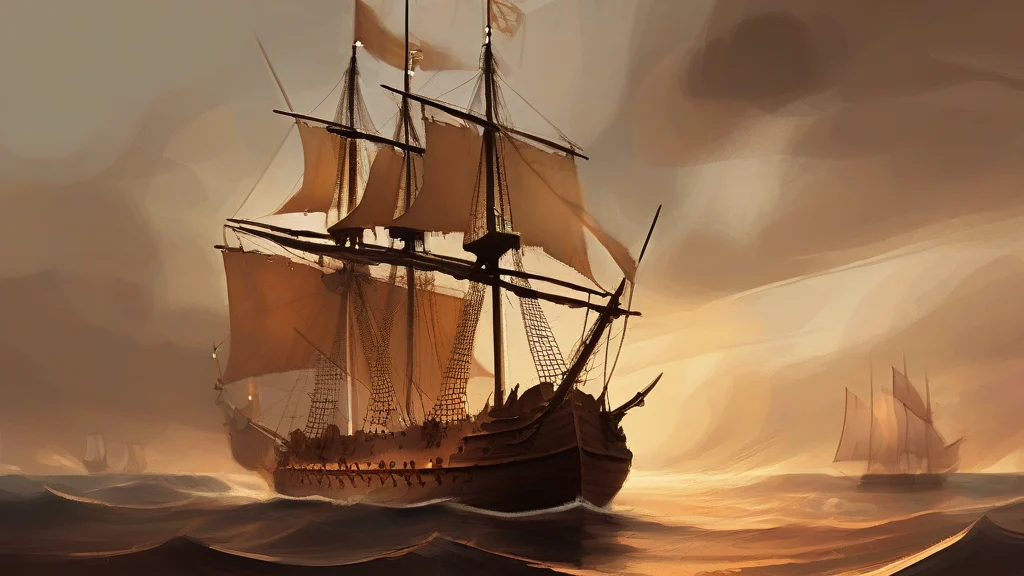
A galleass is a type of large warship used chiefly during the sixteenth and early seventeenth centuries, especially in the Mediterranean. It grew out of the traditional galley, retaining long banks of oars but adding masts and sails along with a much bulkier hull, higher freeboard, and heavier armament. The result was a vessel that could fight under sail when winds allowed yet manoeuvre independently of them when calm or battle demanded — a hybrid well suited to the coastal warfare of the era. Galleasses served most famously with Venice and Spain, playing a notable role at the Battle of Lepanto in 1571 and forming part of the Spanish Armada in 1588. By the mid-seventeenth century advances in sailing warship design had made them obsolete. Today the word survives mainly in naval history writing, where its connotations are those of grandeur and heavy, deliberate power rather than speed.
nounA galleass is a large, heavily armed warship of the 16th and early 17th centuries that combined oars with sails, developed from the Mediterranean galley but broader, taller, and more heavily gunned.
- A large, heavily armed 16th–17th century warship propelled by both oars and sails, evolved from the Mediterranean galley as an augmented (larger) version of it.
"The Venetian galleasses formed a floating bulwark at the front of the Christian line at Lepanto in 1571."
"The Spanish Armada of 1588 included four great galleasses, among the most formidable vessels afloat at the time."
"Museum models and period engravings show the galleass as a hybrid: cannon-lined decks above, tiers of rowers below."
The standard plural keeps the double s: 'the galleasses of the Armada'. The variant spelling 'galleas' exists historically but 'galleass' is the accepted modern form.
"Six Venetian galleasses anchored ahead of the allied fleet at Lepanto."
At the Battle of Lepanto in 1571, just six Venetian galleasses — essentially floating fortresses rowed by hundreds of men — helped shatter the largest Ottoman fleet ever assembled.
Reviewed by Deb Chak, Editor. AI-assisted content curated by RJS Tech Solutions LLP.
Etymology of galleass
The word 'galleass' derives from Old French 'galeasse' (also appearing in Italian as 'galeazza'), an augmentative form built on 'galée', the word for a galley — the '-asse' suffix marking a larger, more powerful version of the base vessel. It entered English usage in the sixteenth century, coinciding with the height of these ships' naval importance. Its lineage ties it to 'galley' itself and to related Mediterranean oared-vessel terms such as 'galleon' and 'galiot'.
How galleass is actually used
The word is almost entirely historical and technical today, encountered mainly in naval history, maritime archaeology, and museum contexts rather than general conversation. It is a formal noun referring specifically to Renaissance-era vessels; using it of any modern ship would be inaccurate.
Easily confused with galleass
A galleon was a purely sail-driven ocean-going ship, whereas a galleass was larger, carried banks of oars as well as sails, and was designed mainly for Mediterranean warfare.