
What does carrick mean?
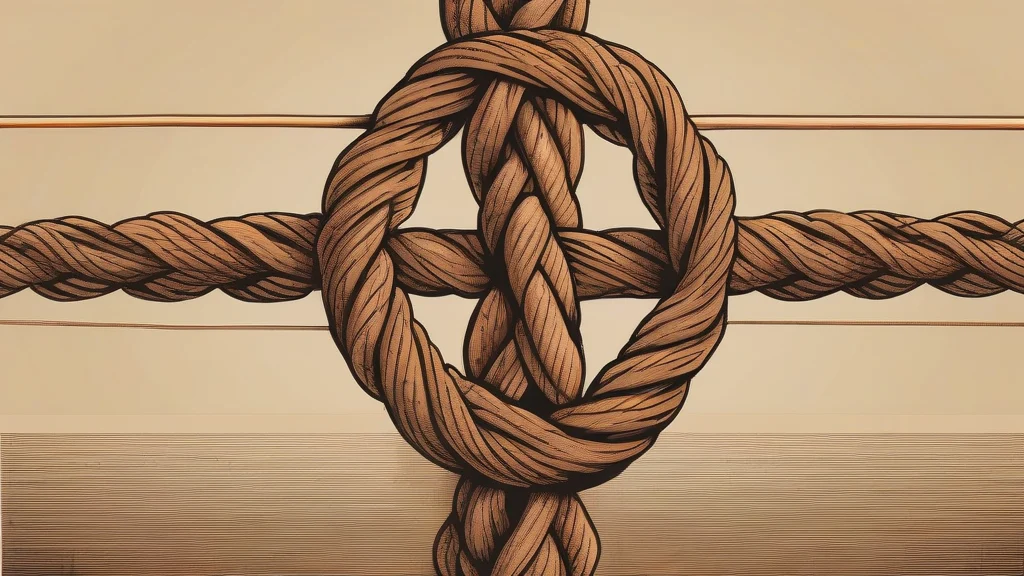
Carrick is a small word with outsized reach across seamanship, history, and geography. Its most familiar modern use is in the carrick bend, a flat, symmetrical knot prized by sailors for joining two ropes securely while remaining easy to untie even after heavy strain. Centuries earlier, the same word named a carrick — a bulky, high-sided merchant vessel that carried Europe's trade through the late Middle Ages, though this sense now survives mainly in historical writing and in the alternate spelling carrack. The word's oldest layer comes from Gaelic carraig, meaning rock, which explains why Carrick turns up so often in place names across Scotland and Ireland, typically marking coastal headlands and stony ground. Today, readers are most likely to meet carrick in knot manuals, maritime histories, or on maps, where it quietly preserves both the language of old wooden ships and the rugged Celtic landscape they once sailed past.
A symmetrical knot used to join two ropes or cables together; short for carrick bend.
"He finished the splice with a neat carrick before coiling the line."
Usually encountered within the full phrase 'carrick bend'.
A large, round-bowed merchant sailing ship of the European Middle Ages; a spelling variant of carrack.
"The carrick carried wool and wine between Bristol and Bordeaux."
Historical usage only; 'carrack' is the standard modern spelling.
Applies when referring to multiple ships of this type or, rarely, multiple instances of the knot.
"Two great carricks lay anchored off the quayside."
The same little syllable names a sturdy nautical knot, a medieval cargo ship, rocky Irish headlands, and half of Scotland's Carrick-a-Rede rope bridge country.
Reviewed by Deb Chak, Editor. AI-assisted content curated by RJS Tech Solutions LLP.
Etymology of carrick
The word has two distinct streams of origin. As a ship name, carrick came into English in the medieval period via Anglo-Norman and Old French, ultimately related to the term now standardised as carrack. Independently, the geographic use derives from Scots and Irish Gaelic carraig, meaning rock, which underlies place names such as Carrickfergus ('rock of Fergus') and connects it to Celtic words like crag.
How carrick is actually used
Outside nautical circles, 'carrick' appears most often as part of proper nouns — place names like Carrickfergus in Northern Ireland and Carrick in Scotland, plus personal and family names. In everyday prose about knots, sailors almost always say the full phrase 'carrick bend' rather than using the word alone.
Easily confused with carrick
A 'carrack' is specifically the large medieval merchant or warship, whereas 'carrick' is more often the knot term and place/surname spelling.
A carriage is a wheeled vehicle for transporting people, unrelated in meaning to carrick despite the similar opening letters.