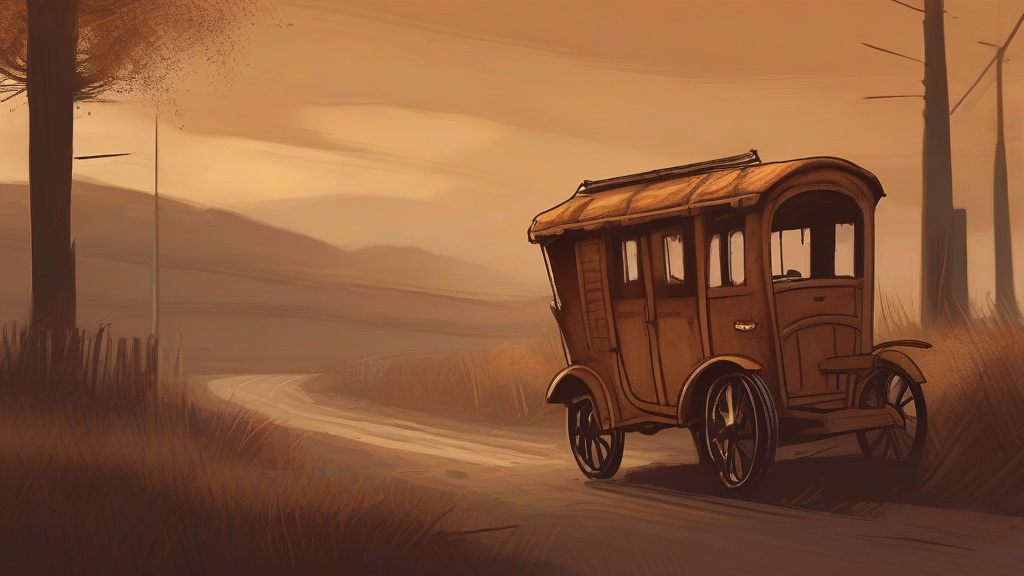
What does carriole mean?
A carriole is a small, light, open horse-drawn carriage, usually two-wheeled, built to carry one or two people. The word entered English from French, where it remains a diminutive form related to 'carre', a cart, ultimately tracing back to the Latin 'carrus', the root that also gave English 'car', 'carriage', and 'chariot'. The term is strongly associated with nineteenth-century France and especially French Canada, where farmers and country doctors relied on the carriole as a simple, inexpensive conveyance; in Canadian usage it could even be fitted with runners in winter to serve as a light sleigh. Today the word survives mainly in historical writing, travel literature, and museum contexts, lending any sentence that uses it an old-fashioned, rustic charm. It is sometimes spelled 'cariole', a fully accepted variant, though neither spelling should be confused with unrelated words such as 'carioca'.
nounA small light open horse-drawn carriage, typically seating one or two people on two wheels; the term is especially associated with French Canada and rural France.
- A small, light, open two-wheeled horse-drawn carriage for one or two people.
- (Historical, Canadian) A light sleigh mounted on runners, used as the winter counterpart of the wheeled carriole.
"In the old photograph, a farmer's wife rode into town in a wooden carriole drawn by a single horse."
"The doctor made his rural rounds each morning in a battered carriole pulled by a single trotting horse."
"When the deep snows arrived, the family swapped the carriole's wheels for runners so it could glide across the drifts."
Regular plural; simply add -s.
"A dozen carrioles were parked outside the church on Sunday mornings."
Long before snowmobiles ruled Quebec's winters, the same word — carriole — named both the summer's light horse cart and its runner-sled replacement.
Reviewed by Deb Chak, Editor. AI-assisted content curated by RJS Tech Solutions LLP.
Etymology of carriole
English borrowed 'carriole' from French in the early nineteenth century, during a period when travel writing brought many French carriage terms across the Channel. The French word is a diminutive of 'carre', meaning a cart or wagon, which derives from Latin 'carrus', a two-wheeled Gallic-style cart adopted into Latin and ultimately ancestral to English 'car', 'carriage', and 'chariot'. The variant spelling 'cariole' reflects the same borrowing through slightly different channels.
How carriole is actually used
The word is now chiefly historical or literary, evoking nineteenth-century rural life in France and French Canada. It appears most often in travel writing and regional histories rather than everyday speech.
Easily confused with carriole
Cariole is an accepted variant spelling of the same word and means the same thing; neither should be confused with 'carioca', which is a dance or a person from Rio de Janeiro.
A carryall is a larger covered carriage or vehicle used for transporting goods or several passengers, while a carriole is a small, light, usually open carriage for one or two riders.