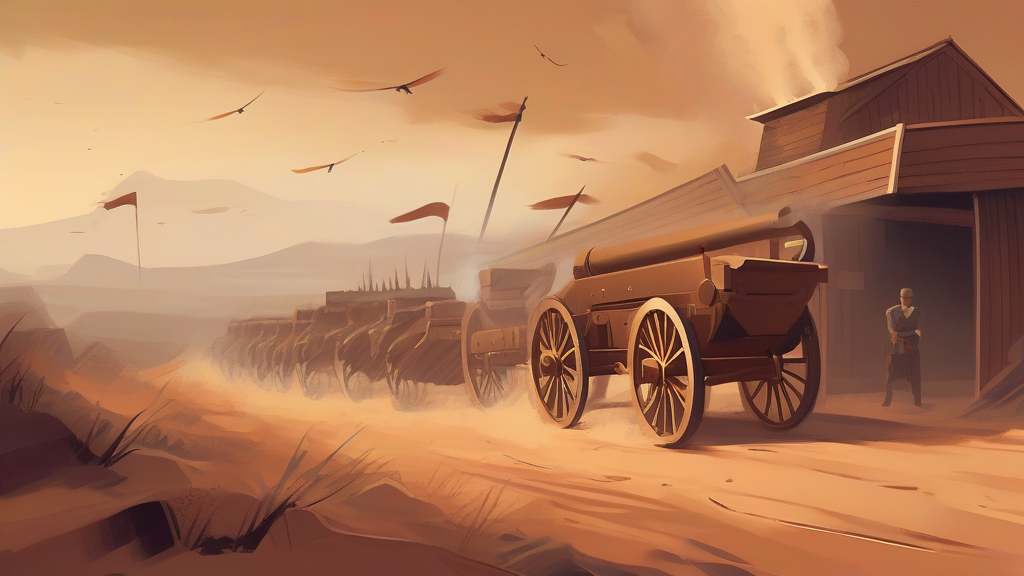
What does carronade mean?
A carronade is a short, smoothbore cast-iron cannon developed in the late 1770s by the Carron Company of Falkirk, Scotland, taking its name from the nearby River Carron. Lighter and more compact than standard long guns, carronades fired heavier shot over shorter distances, delivering devastating force at close range — British sailors nicknamed them 'smashers'. They were widely mounted on Royal Navy warships during the American Revolutionary and Napoleonic wars, often along upper decks to supplement conventional artillery. Their drawbacks included limited range and accuracy compared with long guns, and they gradually fell out of use by the mid-nineteenth century. Today the word appears mostly in naval history, museum interpretation, and historical fiction about the age of fighting sail.
nounA short, smoothbore cast-iron cannon of large caliber, developed in the late eighteenth century and used chiefly on warships for close-range action.
- A short, large-caliber naval gun used at close range, invented in the late 1770s by the Carron Company of Falkirk, Scotland.
- (By extension) any similar short-barreled heavy gun.
"The frigate's deck was lined with carronades, ready to fire devastating broadsides at point-blank range."
"HMS Victory carried carronades on her quarterdeck alongside her long guns."
"A single well-placed round from the carronade could splinter an enemy ship's hull at close quarters."
Standard English plural; ships are typically described as carrying a number of carronades.
"Her carronades were run out just before the enemy came within range."
Named after the River Carron in Scotland, where it was forged — this stubby little cannon hit so hard that sailors called its shot 'smashers'.
Reviewed by Deb Chak, Editor. AI-assisted content curated by RJS Tech Solutions LLP.
Etymology of carronade
The word derives from the Carron Company ironworks in Falkirk, Scotland, named after the River Carron, where the weapon was first manufactured in the late 1770s. It is a modern coinage from a proper noun rather than an inherited classical root, so it has no Latin or Greek cognates. The related term caronade reflects an early variant spelling.
How carronade is actually used
A historical/technical term; today found mainly in discussions of Napoleonic-era naval warfare, maritime museums, and historical fiction. The adjective form is rare; the word functions almost exclusively as a noun. Plural: carronades.
Easily confused with carronade
Not commonly confused; carronade is sometimes misspelled as 'carronade' variants like 'cannonade', which is actually a distinct word.