
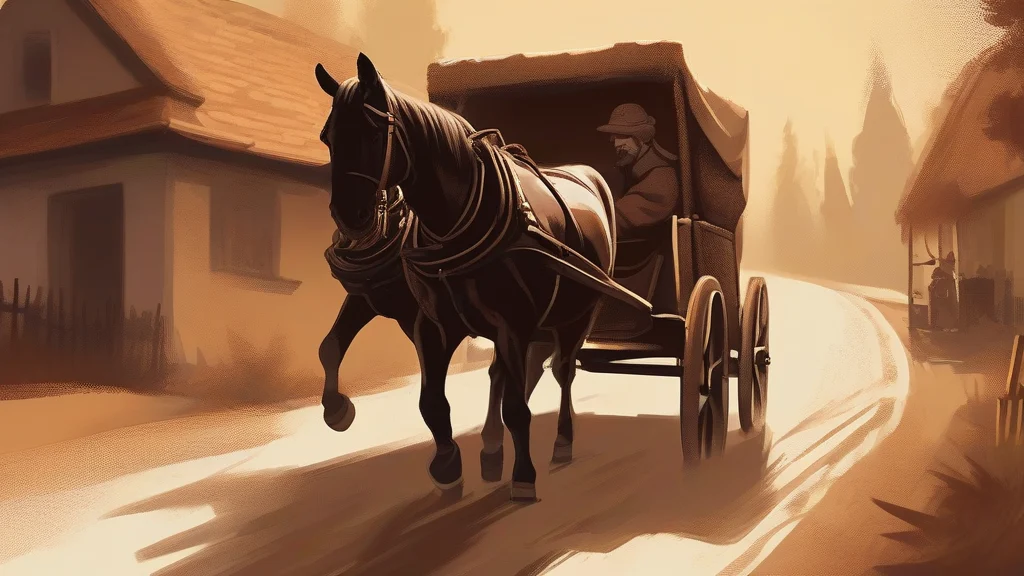
What does carter mean?
A carter is a person whose work is the conveyance of goods by cart — traditionally a horse-drawn vehicle — typically hauling freight for hire between markets, farms, mines, and towns. The word belongs chiefly to the pre-motor era: when railways and roads depended on horsepower for short-haul deliveries, carters were indispensable figures in both rural and urban economies, moving coal, milk, bricks, and produce. Today the term survives mainly in historical writing, heritage museums, and literature evoking an earlier age of transport, and it endures widely as a common English surname, originally denoting someone who drove a cart for a living. Related occupational terms include drayman and haulier, though these carry their own nuances. For readers, "carter" offers a compact window into a vanished trade: understanding it illuminates not only old texts and records but also the everyday language of commerce, where so many surnames — Smith, Cooper, Carter — began as job descriptions.
nounA person whose job is transporting goods by cart, especially a driver of a horse-drawn cart; historically, one who conveyed loads for hire.
- A person who drives or conveys goods by cart, especially for hire.
- (Historical) A laborer employed to transport materials such as coal, timber, or farm produce using a horse-drawn cart.
"In the days before lorries, the village carter delivered coal to every household on his route."
"The carter loaded crates of vegetables at dawn and set off along the muddy lane to market."
"Her great-grandfather worked as a carter, hauling bricks across London with a shire horse named Duke."
Regular plural; used when referring to multiple cart drivers collectively.
"By noon, the market square was crowded with carters unloading their wares."
Before the truck, there was the carter — the original last-mile delivery service, powered entirely by oats.
Reviewed by Deb Chak, Editor. AI-assisted content curated by RJS Tech Solutions LLP.
Etymology of carter
Carter is formed from Middle English "cart," itself borrowed from Old Norse "kartr," with probable influence from Anglo-Norman "caret." The agentive suffix "-er" was added to denote one who works with or drives a cart, making it a classic English occupational surname that appears in medieval records. It shares its Germanic root family with words like cargo and charge, which entered English through Romance routes but descend ultimately from the same Latin "carrus," meaning a two-wheeled wagon.
How carter is actually used
The word is now largely historical or rural in flavor, since motor transport has replaced horse-drawn carts. It survives in surnames (Carter), place names, and literary or heritage contexts. In modern British English it may sound quaint; American usage is rarer still.
Easily confused with carter
"Carter" is an occupation noun for a cart driver, while "Cartier" is a French surname and luxury jewelry brand.
A "carter" transports goods by cart, whereas a "carder" combs wool or commits identity fraud by trading stolen card data.