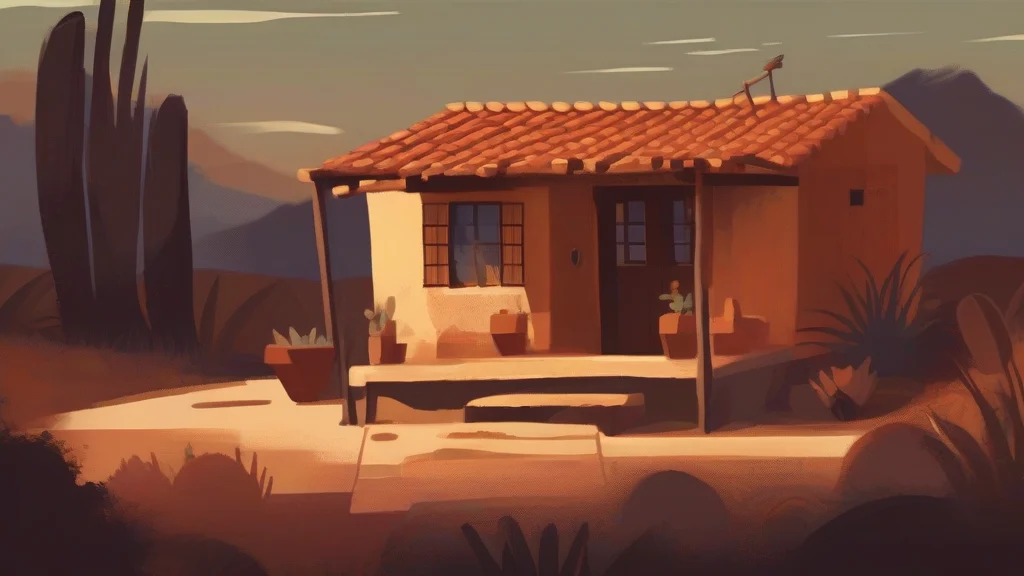
What does casita mean?
A casita is a small house or modest dwelling, the word being borrowed unchanged from Spanish, where it functions as the diminutive of 'casa', meaning house. In everyday English it most often denotes a compact, charming home — sometimes freestanding, sometimes a smaller structure built beside or behind a larger residence. In the southwestern United States, particularly Arizona, New Mexico, Texas, and Southern California, the term has taken on a specific real-estate meaning: a self-contained secondary unit on the same lot as a main house, used for guests, extended family, or rental income. The word carries warm, inviting connotations, evoking adobe walls, tiled courtyards, and leisurely travel, which explains its popularity in hospitality and property listings. Fully naturalized in English yet retaining its Spanish character, 'casita' offers writers a more evocative alternative to plain terms like 'hut' or 'annex'.
nounA small house or modest dwelling, especially one attached to or situated near a larger residence; the word is borrowed directly from Spanish, where it is a diminutive of 'casa' (house).
- A small house or cottage, especially in Spanish-speaking regions or communities.
- In the southwestern United States, a small secondary dwelling on the same property as a main house, often used as a guesthouse or rental unit.
"They converted the backyard casita into a guest suite for visiting relatives."
"The hacienda's whitewashed casitas opened onto a courtyard shaded by olive trees."
"Rather than build an addition, they added a detached casita in the garden for their aging parents."
Standard English pluralization applies; the word does not change form beyond adding -s.
"The village consists of a dozen whitewashed casitas clustered around a central plaza."
'Casita' literally means 'little house' in Spanish — and in America's Southwest, that little word now sells big: real estate listings use it to add charm (and thousands of dollars) to tiny backyard homes.
Reviewed by Deb Chak, Editor. AI-assisted content curated by RJS Tech Solutions LLP.
Etymology of casita
Casita comes from Spanish, formed by adding the diminutive suffix '-ita' to 'casa', meaning house. 'Casa' itself derives from Latin 'casa', which originally referred to a humble hut or cottage before broadening to mean any dwelling. English adopted the term relatively recently, largely through contact with Spanish-speaking cultures in the Americas, and it remains especially associated with the architecture and lifestyle of the American Southwest. The same Latin root also gave rise to other borrowings such as 'casino', originally an Italian diminutive of 'casa'.
How casita is actually used
The word carries warm, picturesque connotations and is common in travel writing and real estate marketing, particularly in the American Southwest, California, and Texas. It is fully naturalized in English but retains its Spanish flavor; it takes English pluralization ('casitas').
Easily confused with casita
A 'cassette' (often misspelled 'casette') is a small sealed container holding magnetic tape for audio recording, whereas a casita is a small house.