What does cassocked mean?
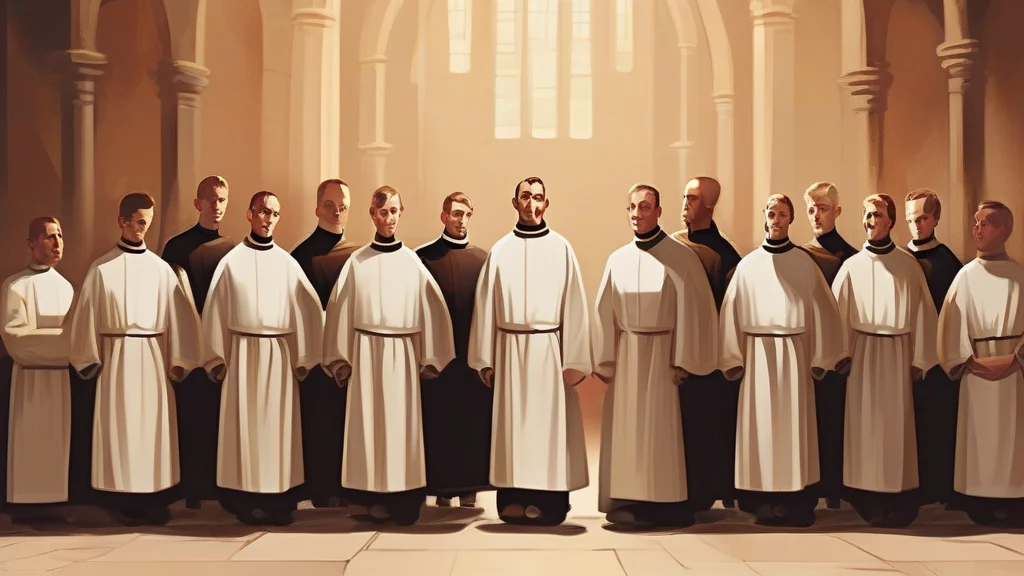
"Cassocked" is a literary adjective describing someone who is wearing a cassock — the long, close-fitting, ankle-length robe traditionally worn by Anglican and Roman Catholic clergy, as well as by altar servers, organists, and choristers. Formed from the noun "cassock," it most often appears before the person it describes, as in "a cassocked priest" or "the cassocked figures gathered near the altar." The word carries strong visual and ceremonial connotations, evoking solemnity, tradition, and the quiet atmosphere of churches and religious ritual, which makes it a favourite of novelists and journalists writing descriptive prose about ecclesiastical settings. It is formal rather than colloquial and is rarely heard in casual conversation, though its meaning is immediately transparent to readers familiar with church life. For writers seeking a single compact word to conjure the image of robed clergy, "cassocked" offers precision and atmosphere that a plainer phrase like "wearing a robe" cannot match.
adjectiveWearing or dressed in a cassock, the long, close-fitting ankle-length robe worn by clergy and others such as altar servers and choristers.
- Wearing a cassock; dressed in the long close-fitting garment worn by clergy, altar servers, and choristers.
"The cassocked priest moved quietly through the dim nave, lighting candles before dawn mass."
"A cassocked acolyte carried the processional cross down the centre aisle."
"In the candlelight, the cassocked choirboys looked almost identical to one another."
One word turns an ordinary priest into a striking visual image: "a cassocked figure at the door" instantly paints the whole scene.
Reviewed by Deb Chak, Editor. AI-assisted content curated by RJS Tech Solutions LLP.
Etymology of cassocked
The adjective "cassocked" derives from the noun "cassock," which entered English from French "casaque" in the mid-16th century. The French term itself likely came via Spanish or Italian from a Turkic source, originally denoting any long outer garment before narrowing to the clerical robe. English speakers added the participial suffix "-ed" to create an adjective meaning "clad in a cassock."
Related word forms
How cassocked is actually used
Literary and somewhat formal in register; it appears most often in descriptive prose about church services, clergy, or historical fiction rather than in everyday speech. It is a participial adjective formed from the noun "cassock," so it typically precedes the noun it modifies ("a cassocked vicar") but may also follow linking verbs.
Easily confused with cassocked
"Cassock" is the noun for the long clerical robe itself, while "cassocked" is the participial adjective describing someone wearing it.