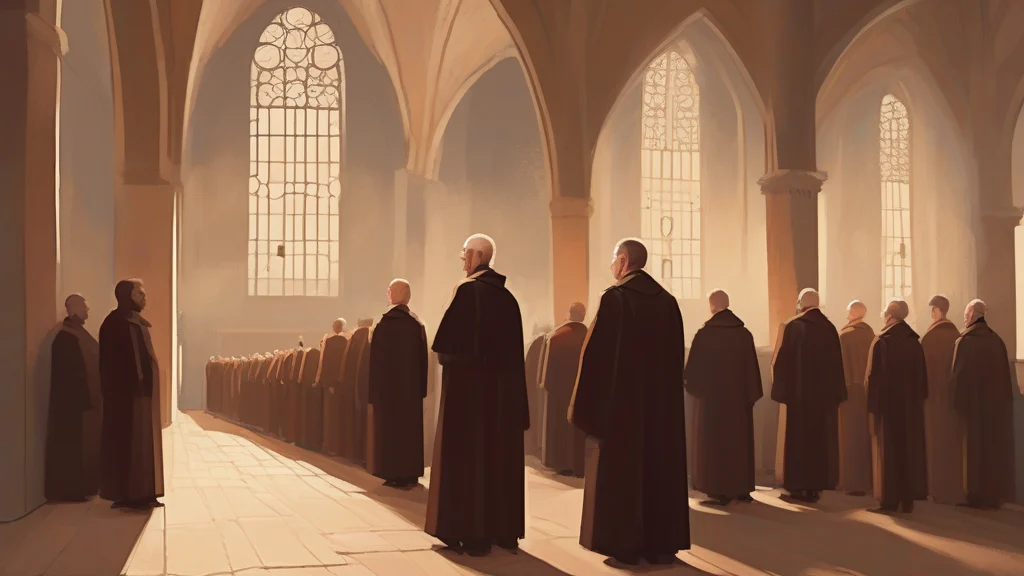
What does cassock mean?
A cassock is a long, ankle-length, close-fitting garment, usually black and buttoned from throat to hem, traditionally worn by Christian clergy — particularly Roman Catholic, Anglican, and Eastern Orthodox priests — as well as by choir members, vergers, and certain academics. It functions as everyday clerical dress rather than a ritual vestment; more ornate garments are worn over it during services. The word carries strong associations with religious life and institutional tradition, so describing someone as 'in cassock' immediately signals a clerical or ecclesiastical setting. The term entered English in the sixteenth century, likely via French 'casaque', with ultimate origins that may lie in Turkic languages. Its most familiar collocations include 'black cassock' and the pairing 'cassock and surplice', which describes standard Anglican choir and clerical dress. For readers of literature, history, or religious writing, recognizing the word helps evoke the visual world of churches, seminaries, and cathedral processions with precision.
nounA long, close-fitting garment reaching to the ankles, worn by members of the clergy and others such as choir members and academics, typically buttoned down the front.
- A full-length, close-fitting outer garment with buttons down the front, worn especially by Roman Catholic, Anglican, and Eastern Orthodox clergy, and also by choir members, vergers, and some academics.
- (Less commonly) any similar long coat or tunic worn historically, such as a soldier's or horseman's garment.
"The priest pulled on his black cassock before the morning service."
"Father O'Brien wore his black cassock as he greeted parishioners after Mass."
"The cathedral choir processed in white surplices over dark cassocks."
Regular plural; used when referring to multiple garments or to groups of clerics collectively.
"A line of seminarians in identical black cassocks filed into the chapel."
The word 'cassock' may share its distant origins with 'Cossack' — both possibly tracing back to a Turkic word for a horseman's long coat.
Reviewed by Deb Chak, Editor. AI-assisted content curated by RJS Tech Solutions LLP.
Etymology of cassock
'Cassock' entered English around the mid-sixteenth century, borrowed from French 'casaque', meaning a long coat or cloak. The further origin is debated but often traced to Turkic sources, possibly the same root that gave us 'Cossack', originally referring to a horseman's garment. Over time the English word narrowed from general long coats to denote specifically the clerical garment known today.
Related word forms
How cassock is actually used
The word belongs chiefly to ecclesiastical and formal religious contexts; it is neutral in register but rarely appears in casual conversation. Among clergy, distinctions are sometimes drawn between the everyday street cassock and liturgical vestments worn over it — a cassock is itself an undergarment relative to items like the chasuble or surplice.
Easily confused with cassock
A hassock is a thick cushion or kneeling pad used in church, while a cassock is the long robe worn by clergy.