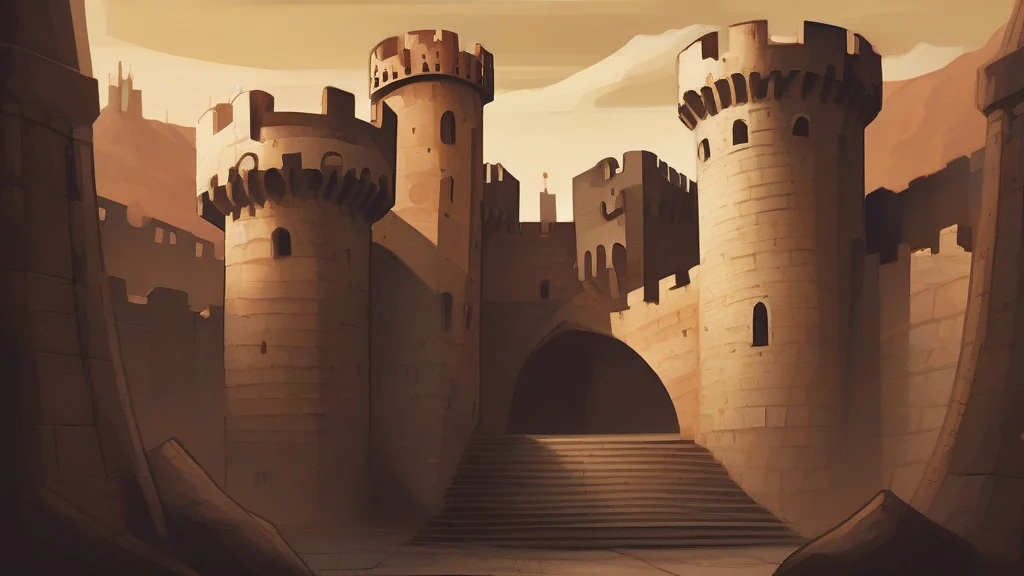
What does castellated mean?
Castellated is an adjective describing something built, shaped, or ornamented like a castle. Its most familiar use applies to buildings — towers, gatehouses, mansions, or churches crowned with battlements — whether genuinely defensive structures from the medieval period or later imitations, such as the many Gothic Revival country houses of the eighteenth and nineteenth centuries that adopted a castellated silhouette for romantic effect. The word can also describe any object whose edge is broken into regular notches resembling those battlements: engineers, for example, may refer to a castellated nut, one whose slotted top allows a split pin to lock it in place. Derived from the Latin castellum, a small fort or stronghold, castellated carries connotations of strength, antiquity, and grandeur. It appears chiefly in architectural description, historical writing, and heritage tourism, where it lends prose a precise yet evocative quality. A close relative, crenellated, refers narrowly to the toothed pattern of battlements themselves, while castellated embraces the broader castle-like character of a whole structure.
adjectiveHaving battlements like a castle, or built or shaped like a castle; also used of objects with a notched or serrated edge resembling crenellations.
- (of a building) Built or decorated in the style of a castle, typically having battlements.
- (of an edge or surface) Notched or serrated so as to resemble battlements.
"The castellated tower rose above the misty moor, its battlements silhouetted against the grey sky."
"The castellated gateway still guards the entrance to the old estate."
"The machinist examined the castellated nut before fitting it to the bolt."
A Victorian banker could live in a 'castellated' house without a single stone being medieval — the word simply meant it looked ready for battle.
Reviewed by Deb Chak, Editor. AI-assisted content curated by RJS Tech Solutions LLP.
Etymology of castellated
Castellated derives from Latin castellum, a diminutive of castrum meaning 'fortress' or 'stronghold', which passed into Old French as castel and thence into Middle English as castle. The verb castellate, meaning to furnish with battlements or make castle-like, emerged in English around the late sixteenth or early seventeenth century, and the adjective castellated followed soon after. It shares its root with words such as castellan, château, and castellum itself.
Related word forms
How castellated is actually used
Mostly formal or architectural in register; common in descriptions of historic buildings, Gothic Revival architecture, and occasionally engineering (for notched mechanical parts).
Easily confused with castellated
Crenellated specifically describes battlements with alternating gaps and merlons, while castellated more broadly means castle-like in form or having such notched edges.