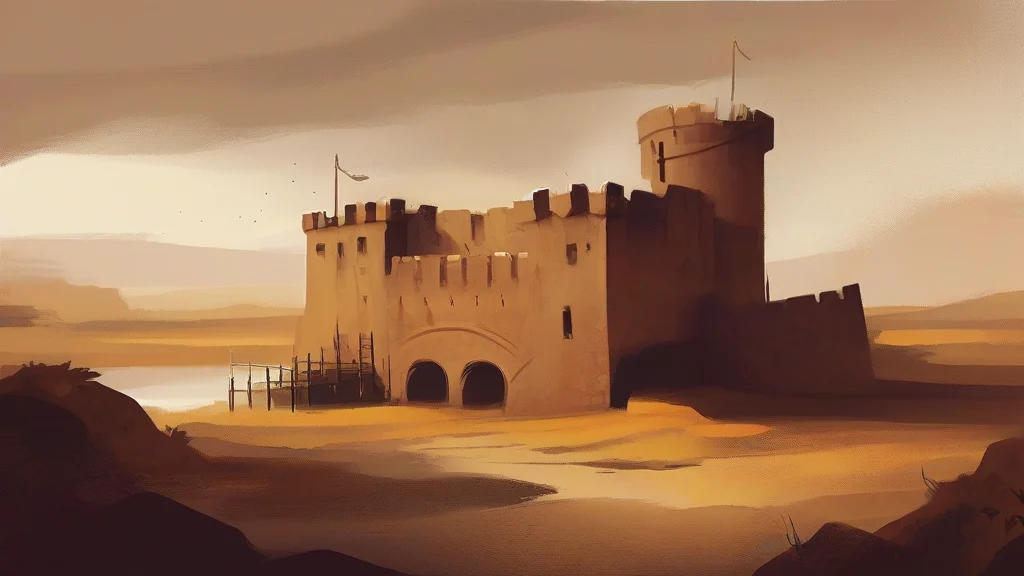
What does castellum mean?
A castellum is a term from Roman antiquity with two related technical meanings. Most commonly, it denotes a small fortified outpost — a minor fort or detached defensive work associated with a larger Roman camp, fort, or frontier line. The word is Latin, a diminutive of castrum ('fort'), so it literally means a little fort, and English borrowed it directly for use in classical archaeology and history. In Roman hydraulic engineering, castellum also names a castellum aquae, a masonry reservoir or distribution tank at which water arriving via an aqueduct was collected and apportioned into smaller pipes serving fountains, baths, and private users; impressive examples survive at Pompeii and Nîmes. The word remains a specialist term rather than everyday vocabulary, carrying a scholarly, historical register. It is best known to readers interested in Roman military architecture or ancient water systems, and it is the direct ancestor of the English word castle.
A small fortified Roman outpost or detached defensive work connected with a larger camp or fortification.
"A garrison of auxiliaries held the castellum that protected the road's northern approach."
Typically encountered in archaeological reports and histories of the Roman army; often italicized as an untranslated Latin term.
In Roman hydraulic engineering, a reservoir or distribution tank (castellum aquae) receiving aqueduct water and dividing it among outlet pipes.
"The castellum at Nîmes regulated the flow of water arriving from the aqueduct near the Pont du Gard."
Restricted to histories of Roman engineering and archaeology of ancient water systems.
The standard plural follows the Latin second-declension neuter pattern (-um → -a), consistent with other learned borrowings such as 'datum/data' and 'bacterium/bacteria'.
"Excavators have identified several castella along the Antonine Wall."
The word 'castle' began life as this modest little structure — 'castellum' is simply Latin for 'a tiny fort.'
Reviewed by Deb Chak, Editor. AI-assisted content curated by RJS Tech Solutions LLP.
Etymology of castellum
Castellum is a direct borrowing from Latin, where it is the diminutive of castrum, meaning a fort or military camp, and thus literally signifies a small fort or fortified place. The same Latin root produced Old French castel, which gave Middle English castle, making castle, castellan, and château all relatives of castellum. In English scholarly writing the Latin form has been retained since at least the early modern period for precisely identifying small Roman forts and, later, Roman water-distribution structures.
How castellum is actually used
A learned, technical term confined largely to classical archaeology, Roman history, and engineering scholarship; it appears rarely in general prose and is usually italicized or glossed when introduced to non-specialist readers. The plural is castella.
Easily confused with castellum
A castle is a large medieval fortified residence, while a castellum is a small Roman military outpost or a water-distribution tank.
A castrum was a full-sized Roman military camp or fortress, whereas a castellum was a smaller, subordinate fortification — the word is literally its diminutive.