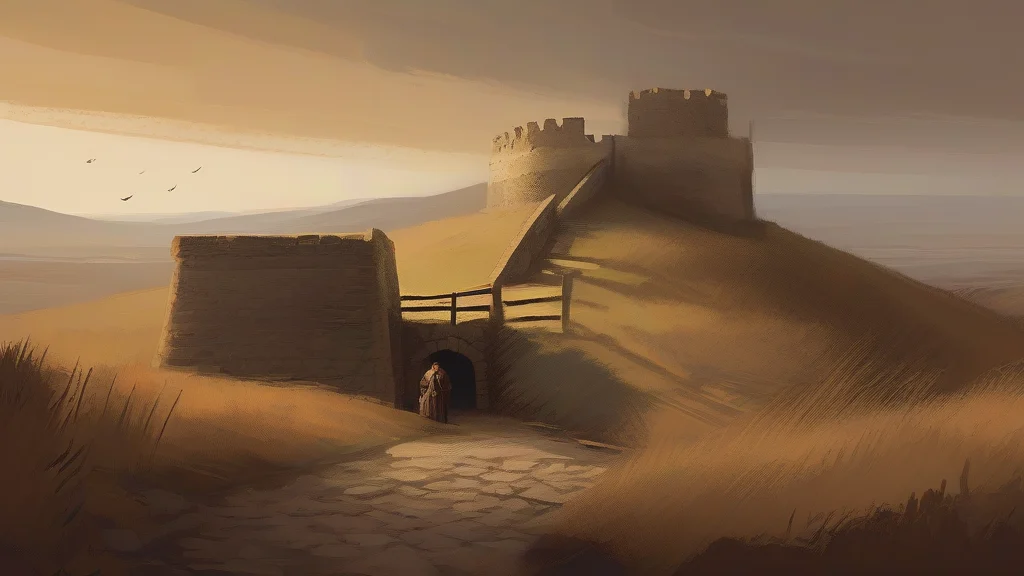
What does fortlet mean?
A fortlet is a small fort — a minor fortified installation considerably more modest than a full military base. The term is most closely associated with Roman frontier archaeology, particularly in Britain, where small fortlets were built along barriers such as the Antonine Wall to house patrols and small detachments rather than large garrisons. Unlike a fort, which served as a permanent stronghold for hundreds of soldiers, a fortlet might shelter only a few dozen men and could serve watch, signalling, or policing functions. Today the word appears almost exclusively in archaeological literature, heritage interpretation, and historical writing about Roman military installations, giving it a specialised rather than everyday register. It remains useful precisely because it captures a category of site too small to be called a fort yet unmistakably military in purpose, allowing historians and archaeologists to describe the finer texture of ancient frontier defences with precision.
nounA small fortified structure or minor fort, especially one of the small Roman military installations built along frontier barriers such as the Antonine Wall in Scotland.
- A small fortified post or minor fort, typically smaller than a standard fort and garrisoned by a limited number of troops.
- (Archaeology/historic terms) Specifically, one of the small Roman installations associated with frontier systems such as the Antonine Wall.
"The patrol took shelter overnight in a crumbling Roman fortlet beside the wall."
"Excavations revealed that the fortlet had housed a detachment of fewer than twenty soldiers."
"A reconstructed timber fortlet now marks the site for visitors walking the frontier trail."
Standard pluralisation with the -s suffix; plural forms appear naturally in survey and excavation reports describing multiple sites.
"Several fortlets once lined the road between the two major forts."
Along Rome's Antonine Wall in Scotland, tiny fortlets were tucked between full-sized forts at regular intervals — so even the empire's smallest outposts left their mark on the map two thousand years later.
Reviewed by Deb Chak, Editor. AI-assisted content curated by RJS Tech Solutions LLP.
Etymology of fortlet
Fortlet combines 'fort', from the Latin fortis meaning 'strong', with the suffix '-let', a diminutive ending used in English to form smaller versions of nouns (as in ringlet and piglet). It emerged as an English compound, likely coined during the period of intense antiquarian and archaeological study of Roman Britain, when scholars needed a term for the small auxiliary posts found alongside major frontier works. Its Latin-rooted relatives include fortress, fortify, and fortitude, all tracing back to the same notion of strength embodied in fortis.
How fortlet is actually used
Fortlet is chiefly used in archaeology, Roman studies, and heritage contexts rather than everyday conversation. The word carries strong associations with Roman Britain and frontier archaeology, so it appears most often in academic writing, site reports, and popular history.
Easily confused with fortlet
A fort is a substantial military stronghold with permanent defenses and a garrison, whereas a fortlet is a much smaller installation, often housing only a handful of soldiers.