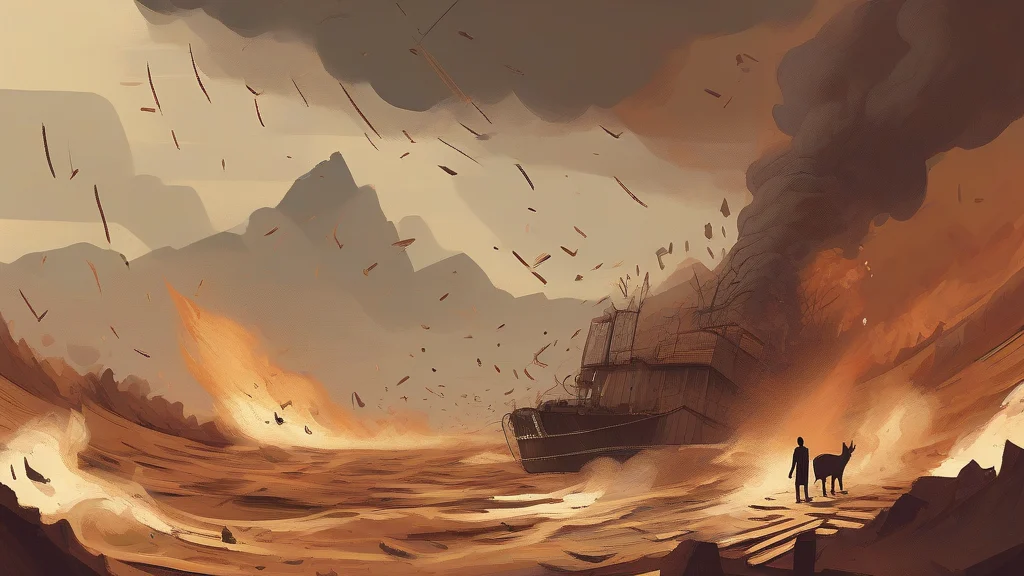
What does cataclasm mean?
Cataclasm is a rare English noun meaning a breaking or shattering into pieces, and by extension a violent disruption or overthrow of an established order. It derives from the Greek kataklastēs ('a breaker') via the root kata-, meaning 'down', combined with klan, 'to break'. In practice, the word is largely literary and somewhat archaic: writers reach for it when they want a forceful, almost physical image of collapse—whether of institutions, traditions, or artistic conventions—rather than a plain statement of disaster. Its far more common cousin, cataclysm, now covers most senses of catastrophic upheaval, particularly natural disasters like floods and earthquakes, leaving cataclasm as the more literal and abstract term for the act of breaking itself. Because of this overlap, the two words are easily confused. Cataclasm also survives in geology through the related adjective cataclastic, describing rocks deformed by fracturing under pressure—a reminder that at heart the word is about things being smashed apart.
nounA breaking or shattering into pieces; a violent disruption or overthrow of an established order. The word is chiefly literary and is often used interchangeably with, or as a variant of, cataclysm.
- A breaking or shattering of something into pieces; a violent disruption or collapse of an established order.
"The revolution brought a cataclasm that swept away centuries of tradition."
"The empire's fall produced a cataclasm that reshaped the entire region."
"Critics described the composer's final symphony as a cataclasm of sound, shattering every convention of the form."
Regular plural; used when referring to multiple distinct events of breakdown or shattering.
"History records few cataclasms as complete as the fall of Rome."
Before 'cataclysm' became the go-to word for disaster, its obscure sibling 'cataclasm' did the heavy lifting—literally meaning a smashing to pieces.
Reviewed by Deb Chak, Editor. AI-assisted content curated by RJS Tech Solutions LLP.
Etymology of cataclasm
Cataclasm comes from the Greek kataklasma, meaning 'a breaking in pieces', formed on the verb kataklaō, 'to break down or shatter', from kata- ('down') and klaō ('to break'). It entered English in the seventeenth century alongside cataclysm, which derives from the same Greek root but originally referred to the biblical Flood. While cataclysm flourished and broadened to mean any great disaster, cataclasm remained rare and literary, surviving mainly in learned or poetic prose and in geological terminology through the derivative cataclastic.
Related word forms
How cataclasm is actually used
Cataclasm is a rare and markedly literary word; most modern readers encounter it far less often than cataclysm, which has absorbed much of its territory. It carries a formal, sometimes deliberately archaic tone, so it suits elevated prose rather than everyday speech.
Easily confused with cataclasm
Cataclysm refers specifically to a sudden, large-scale disaster such as a flood or earthquake, while cataclasm more literally denotes the act of breaking something to pieces and is a rarer, more abstract term.