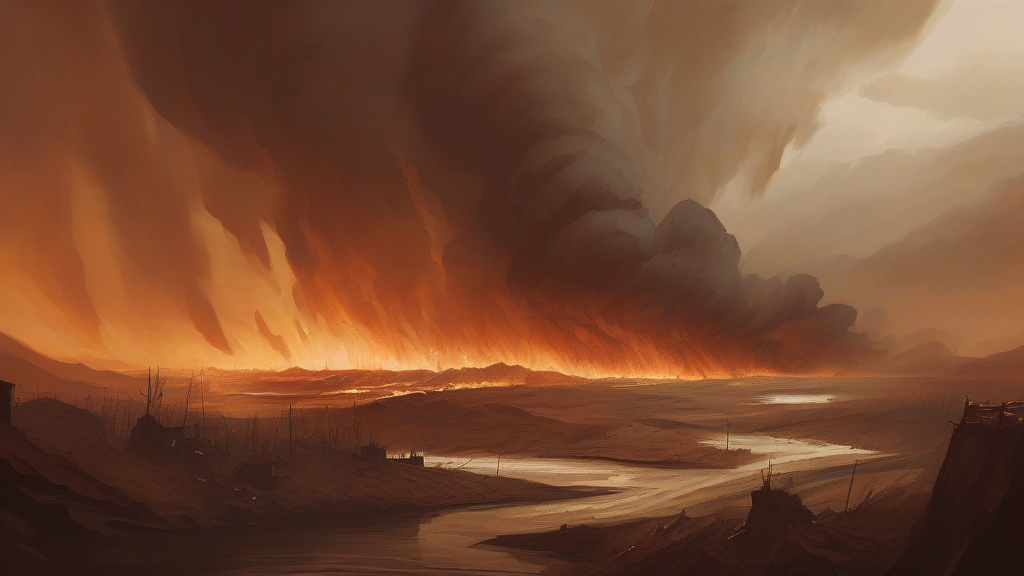
What does cataclysm mean?
A cataclysm is a violent, large-scale event of destruction — originally a natural one such as a great flood, earthquake, or volcanic eruption, but by extension any sudden and sweeping upheaval that transforms or devastates a society. The word carries connotations of overwhelming, almost apocalyptic scale: a factory closing is a setback, but a world war or an asteroid strike is a cataclysm. It belongs chiefly to formal and literary registers, appearing often in historical writing ('the cataclysm of 1914'), scientific prose about mass extinctions, and journalism covering environmental or economic collapse. Derived from the Greek kataklysmos, meaning deluge or flood, it entered English in the early seventeenth century, initially with strong biblical overtones of the Great Flood. Its adjective form, cataclysmic, has become far more common than the noun, used hyperbolically for anything dramatically disruptive. For writers seeking a weightier alternative to 'disaster' or 'catastrophe', cataclysm supplies both gravity and vividness.
nounA large-scale and violent event in the natural world, such as a flood or earthquake; more broadly, a momentous and typically disastrous upheaval or catastrophe.
- A violent, large-scale natural disaster such as a flood, earthquake, or volcanic eruption.
- A sudden, momentous, and usually disastrous political or social upheaval.
"The asteroid impact was a cataclysm that reshaped life on Earth."
"Geologists have found evidence of a cataclysm that buried the coastline under metres of ash."
"The revolution was a cataclysm that swept away the old order overnight."
Standard plural; countable in both literal and figurative senses.
"The region's history is punctuated by cataclysms — floods, famines, and fires that reshaped entire communities."
The word for a world-ending flood comes from the Greek for exactly that: kataklysmos literally means 'deluge' or 'washing down'.
Reviewed by Deb Chak, Editor. AI-assisted content curated by RJS Tech Solutions LLP.
Etymology of cataclysm
Cataclysm derives from the Greek kataklysmos (κατακλυσμός), meaning 'deluge' or 'flood', formed from kata- ('down') and klyzein ('to wash'). It passed into Latin as cataclysmos before entering English in the early seventeenth century, where it first referred to the biblical Flood and other inundations. Over the following centuries its sense broadened from literal floods to encompass earthquakes, then figuratively to any momentous upheaval or disaster. It shares the Greek kata- prefix with words such as catastrophe, catalogue, and catabolism.
Related word forms
How cataclysm is actually used
'Cataclysm' is formal to literary in register and carries a strong connotation of overwhelming scale — it suggests events of civilizational or planetary magnitude rather than personal misfortune. It is frequently used figuratively for wars, revolutions, and economic collapses. The derived adjective 'cataclysmic' is considerably more common in everyday speech than the noun itself.
Easily confused with cataclysm
Both denote disaster, but 'cataclysm' specifically implies a vast, often geological or societal upheaval, whereas 'catastrophe' is the broader, more everyday term for any severe misfortune.
'Cataclysm' is the noun naming the event itself, while 'cataclysmic' is the adjective describing something resembling or producing such an event.