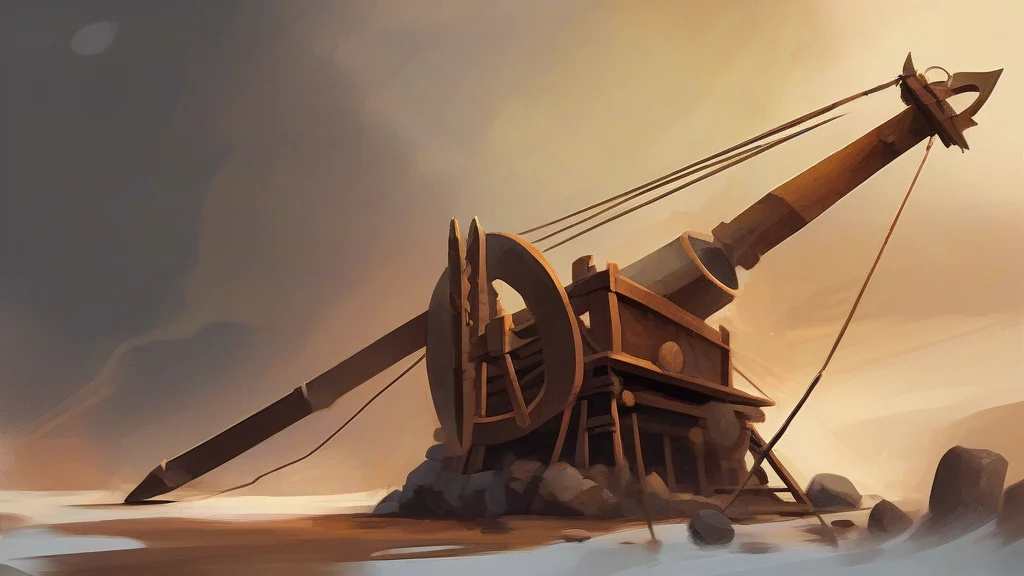
What does catapult mean?
A catapult is a machine designed to hurl heavy objects through the air without explosives, historically used in warfare to break fortifications or rain projectiles on defenders. Ancient Greek and Roman armies relied on various forms of catapults powered by torsion, tension, or counterweight mechanisms. In modern English, the word also functions as a verb meaning to launch something suddenly and with force — whether a physical object, as in aircraft being catapulted from carrier decks, or a person's fortunes, as in being catapulted to fame. This figurative use gives the word a vivid, energetic quality that remains common in journalism and everyday speech. Derived from Greek roots meaning 'to shake down' or 'to pierce,' catapult bridges ancient engineering and modern metaphor, making it both a concrete historical artifact and a lively expression of dramatic momentum.
An ancient military device used for hurling stones, arrows, or other projectiles by means of tension, torsion, or counterweight.
"The museum displayed a reconstructed Roman catapult."
Often used broadly to describe any pre-modern siege engine, though specialists distinguish between types like ballistae, onagers, and trebuchets.
To launch or propel something suddenly and forcefully through the air; figuratively, to cause someone or something to rise rapidly in status or prominence.
"The discovery catapulted the young scientist into international recognition."
Regular plural formation; used when referring to multiple machines or instances.
"The fortress was surrounded by dozens of enemy catapults."
Roman soldiers once fired clay pots full of venomous snakes at their enemies — using nothing but a catapult.
Reviewed by Deb Chak, Editor. AI-assisted content curated by RJS Tech Solutions LLP.
Etymology of catapult
The word 'catapult' derives from the Greek 'katapeltes' (καταπέλτης), formed from 'kata' (downward) and 'pallein' (to toss or hurl), suggesting a device that hurls projectiles downward or forward. It entered Latin as 'catapulta' and was adopted into English in the early 16th century. Cognates appear across European languages through shared Latin inheritance, including French 'catapulte' and Italian 'catapulta.' The verb form emerged later, extending the mechanical sense to figurative launching.
Related word forms
How catapult is actually used
As a noun, 'catapult' most often appears in historical, military, or educational contexts. As a verb, it frequently carries a figurative sense of sudden advancement or dramatic change ('catapulted to stardom'), giving it a dynamic, energetic connotation. The verb form can sound slightly formal or literary in everyday speech.
Easily confused with catapult
A catapult is a general term for projectile-throwing engines using tension or torsion, whereas a trebuchet specifically uses a counterweight mechanism.