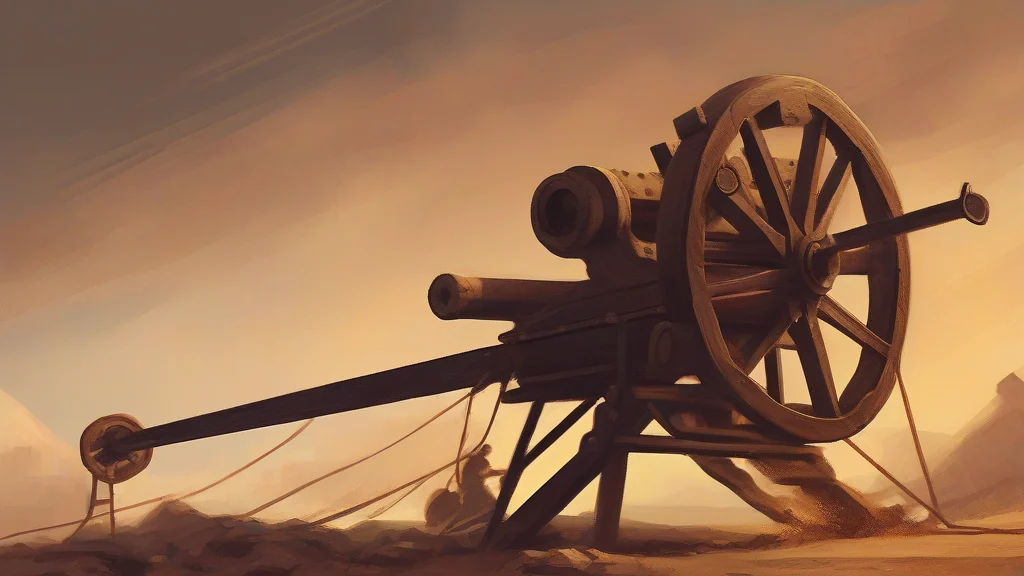
What does ballista mean?
A ballista is an ancient missile weapon used by Greek and Roman armies, best understood as a crossbow scaled up to the size of a piece of field artillery. Powered by skeins of twisted rope or sinew storing torsion energy, it launched heavy iron-tipped bolts or stone shot with considerable force and accuracy, making it a mainstay of siege warfare and battlefield defence. The word derives from the Greek 'ballein', meaning 'to throw', via Latin, and survives today mainly in the related term 'ballistics'. Although obsolete as a weapon since antiquity, the ballista remains a vivid presence in popular culture — appearing in historical novels, documentaries, museums, and strategy games — where it evokes the engineering ingenuity of classical warfare. Its plural, 'ballistae', preserves its Latin heritage.
nounAn ancient military engine, resembling a large crossbow, that hurled heavy bolts or stones over long distances using torsion from twisted cords. It was used chiefly by the Greeks and Romans in siege warfare.
- An ancient Greek and Roman torsion-powered military engine resembling a large crossbow, used to hurl bolts or stones in siege warfare.
"The Roman legionaries wheeled a ballista to the top of the ramp and began raining bolts down on the city walls."
"Archaeologists uncovered the iron bolt-heads fired by a Roman ballista during the siege of the hill fort."
"In his account of the campaign, the historian described how each cohort dragged its ballista along the baggage train."
The plural retains the Latin ending '-ae'; 'ballistas' also occurs but 'ballistae' is preferred in scholarly and historical writing.
"The garrison lined the walls with a dozen ballistae, each capable of punching through shields at range."
The ballista could punch a bolt clean through armour at hundreds of paces — essentially a crossbow the size of a small car.
Reviewed by Deb Chak, Editor. AI-assisted content curated by RJS Tech Solutions LLP.
Etymology of ballista
The word ballista comes ultimately from the Greek verb 'ballein' ('to throw'), passing into Latin as 'ballista'. English borrowed the term directly from Latin, with the earliest recorded uses dating from around the late sixteenth or early seventeenth century. The same Greek root gives us the modern word 'ballistic' and the science of ballistics.
How ballista is actually used
A historical and technical term, encountered mainly in contexts dealing with ancient warfare, archaeology, museum exhibits, and historical fiction or games. The plural 'ballistae' follows Latin convention and is standard in scholarly writing.
Easily confused with ballista
A catapult is a broader term for ancient artillery engines in general (and specifically the arm-throwing type), while a ballista is the torsion engine that works like a giant two-armed crossbow firing bolts or stones along a straight trajectory.
A trebuchet is a medieval counterweight-powered sling engine for hurling stones, whereas a ballista is an ancient torsion-driven device resembling a large crossbow.