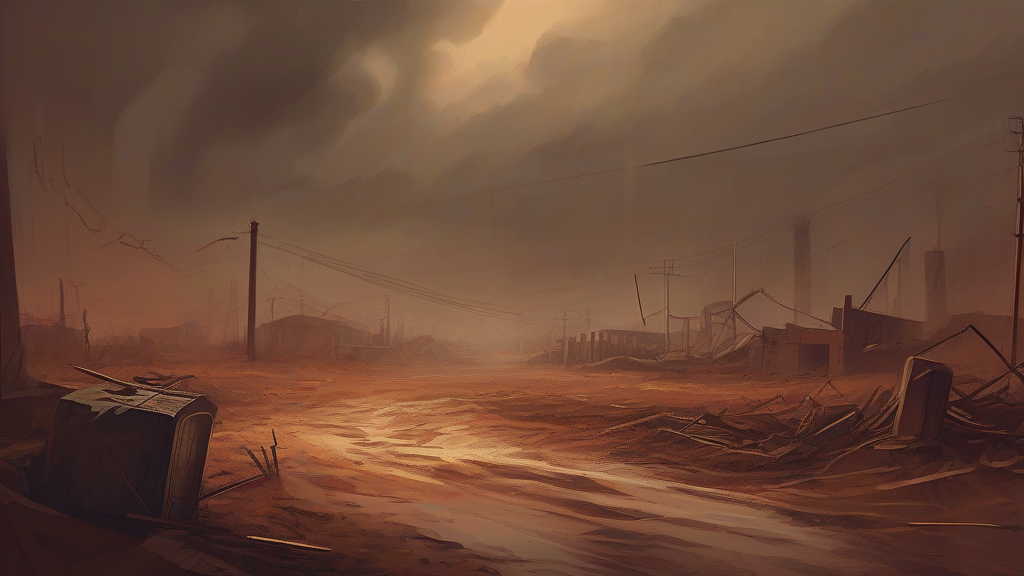
What does catastrophe mean?
A catastrophe is a sudden, large-scale disaster — an event that causes enormous damage, destruction, or human suffering, such as an earthquake, war, or industrial accident. The word implies both magnitude and abruptness: a slow decline is rarely called a catastrophe, but a swift collapse can be. In informal modern usage, the term has broadened considerably, so that a ruined dinner party or a botched presentation may jokingly be described as 'a complete catastrophe,' signalling total failure rather than genuine tragedy. Derived from Greek roots meaning an 'overturning' or 'downward turn,' it originally referred in classical drama to the final resolution of a plot before acquiring its modern sense of ruinous misfortune. Related forms include the adjective 'catastrophic' and the adverb 'catastrophically.' Because it conveys severity so vividly, the word is a staple of journalism, risk assessment, and everyday exaggeration alike, making it one of English's most versatile terms for things going disastrously wrong.
A sudden and widespread disaster; an event causing great and often irreparable damage or suffering.
"The dam's collapse was a catastrophe for villages along the river."
Informally, a complete failure or thoroughly bad situation.
"The launch event was a catastrophe from start to finish."
Standard regular plural; pronounced with a final /z/ sound.
"The twentieth century witnessed catastrophes on an unprecedented scale."
In ancient Greek drama, the 'catastrophe' was simply the story's final turning point — it only became synonymous with disaster over time.
Reviewed by Deb Chak, Editor. AI-assisted content curated by RJS Tech Solutions LLP.
Etymology of catastrophe
Catastrophe comes from the Greek 'katastrophē,' meaning an overturning or sudden turn, formed from 'kata-' (down) plus 'strephein' (to turn). It entered English in the early 17th century, first used in literary criticism to mean the denouement or final resolution of a drama, especially a tragedy. Over time its sense shifted from a mere dramatic conclusion to the disastrous events such conclusions often depicted, yielding today's dominant meaning of a catastrophic disaster. It shares its root with words such as 'catastrophic' and, more distantly, 'apostrophe' and 'strophe,' all built on the Greek verb for turning.
Related word forms
How catastrophe is actually used
The word carries strong connotations of scale and severity — minor mishaps are usually not called catastrophes except in hyperbole. In everyday informal speech it is often used exaggeratedly for trivial failures.
Easily confused with catastrophe
An apostrophe is a punctuation mark or a rhetorical address to an absent thing, whereas a catastrophe is a disaster; they share only Greek roots relating to 'turning.'
A cataclysm typically denotes a violent, large-scale natural upheaval such as a flood, while catastrophe is broader and can describe any disaster or total failure.