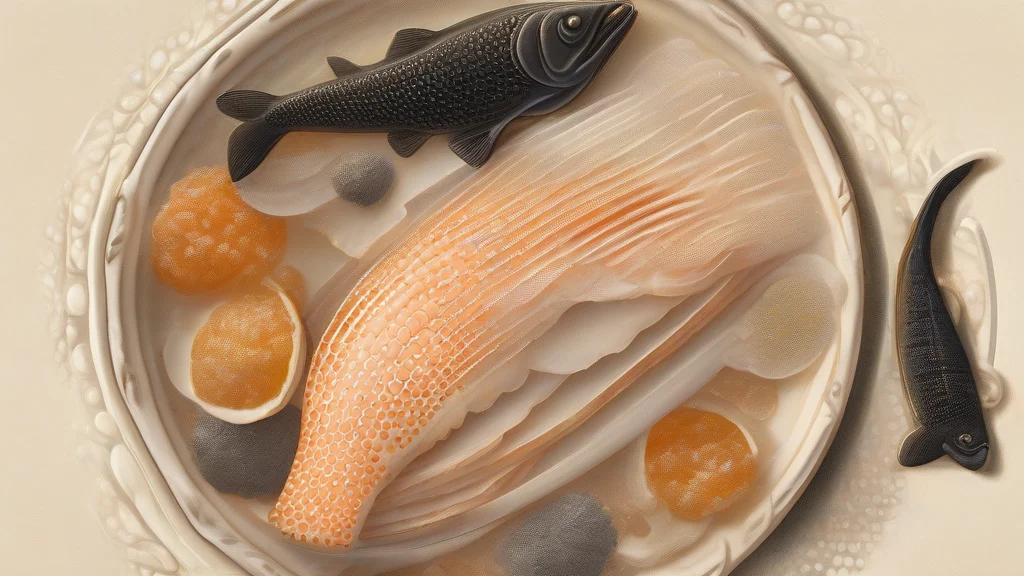
What does caviare mean?
Caviare is a chiefly British variant spelling of caviar, referring to the salted roe of sturgeon and certain other fish, prized worldwide as one of gastronomy's great luxuries. Served chilled in small quantities — often atop blinis, toast points, or with crème fraîche and champagne — true sturgeon caviare commands extraordinarily high prices, with beluga, osetra, and sevruga among the most coveted grades. Beyond the dinner table, the word has acquired a figurative meaning through Shakespeare's Hamlet, where a play that 'pleased not the million' was described as 'caviare to the general', giving English a lasting expression for art too refined for popular taste. In everyday use, caviare connotes opulence, sophistication, and exclusivity, though the spelling itself is now somewhat old-fashioned, with caviar preferred in contemporary writing.
The salted roe of sturgeon or other large fish, eaten as a delicacy, typically served cold in small portions.
"A tin of caviare was the centrepiece of the lavish hors d'oeuvres table."
Mass noun; no plural in standard usage. The spelling 'caviare' is a chiefly British variant, now less common than 'caviar'.
Figuratively, something considered too refined or sophisticated to be appreciated by ordinary people.
"Her experimental jazz compositions were caviare to the general concert-going public."
This sense derives directly from Hamlet's phrase 'caviare to the general' and remains a literary allusion rather than common idiom.
As a mass noun denoting a substance, caviare normally takes no plural. A plural may occasionally appear when referring to multiple types or servings of the delicacy.
"The tasting menu featured three caviares, each from a different sturgeon species."
Shakespeare put it in Hamlet — 'the play pleased not the million; 'twas caviare to the general' — making this delicacy a byword for anything too refined for ordinary tastes.
Reviewed by Deb Chak, Editor. AI-assisted content curated by RJS Tech Solutions LLP.
Etymology of caviare
Caviare entered English in the early 16th century, borrowed from French caviar, which derived from Italian caviale. The Italian term traces back through medieval Greek to Turkish havyar, ultimately from Persian khāvyār, literally 'egg-bearer' or 'fish-egg dish'. The word thus traveled from Persian through Turkish, Greek, and Italian into Western European languages before reaching English.
How caviare is actually used
The spelling 'caviare' is now largely dated or British-formal; 'caviar' is the dominant modern spelling in both varieties of English. The word carries connotations of luxury, exclusivity, and refinement.
Easily confused with caviare
Caviare is simply a British variant spelling of the same word; both refer identically to salted fish roe.