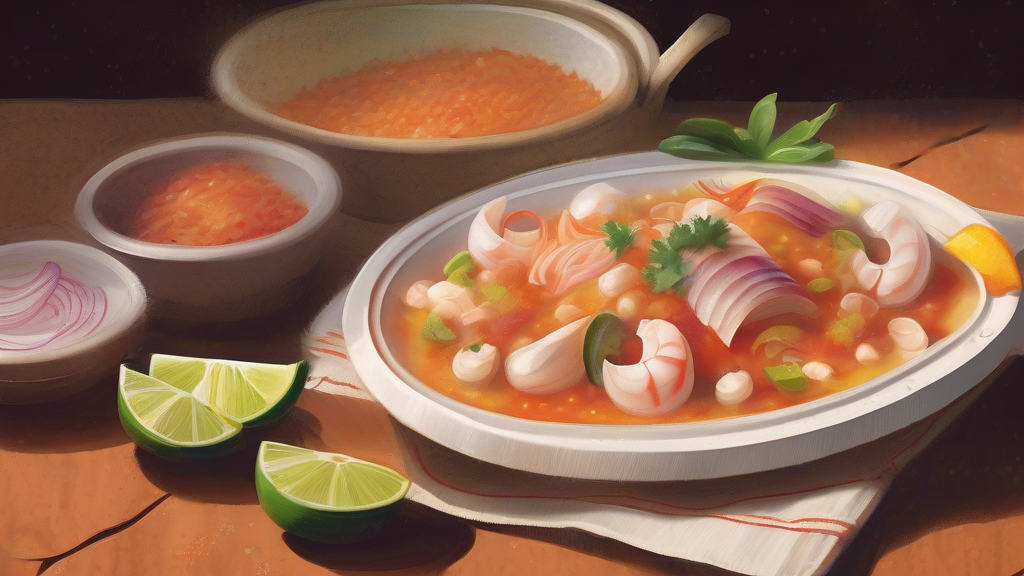
What does ceviche mean?
Ceviche is a dish of raw fish or shellfish that is marinated in citrus juice — most often fresh lime — together with sliced onion, chilli, coriander, and salt. The acid in the juice denatures the proteins in the seafood, turning it firm and opaque in a process commonly described as 'cooking without heat', though the fish is never exposed to fire. Ceviche is a cornerstone of coastal Latin American cuisine, with Peru and Mexico especially celebrated for their versions; Peruvian ceviche, typically paired with sweet potato and maize, is regarded as national heritage. In English, the word functions as both a mass noun and, occasionally, a countable one, and it appears frequently on modern restaurant menus, where it signals freshness and bright, assertive flavour. Its rising international popularity has made it a familiar borrowing well beyond Spanish-speaking communities.
nounA Latin American dish of raw fish or seafood marinated in citrus juice, typically lime, which 'cooks' the flesh by denaturing its proteins, usually combined with onion, chilli, coriander, and other seasonings.
- A dish of raw fish or seafood cured in citrus juice and seasoned with onions, chillies, and herbs, popular throughout Latin America and increasingly worldwide.
"The coastal restaurant is famous for its lime-brightened sea bass ceviche served with sweet potato and corn."
"For starters we ordered a tangy shrimp ceviche with tortilla chips."
"Peru has declared ceviche part of its national cultural heritage."
The plural is uncommon because ceviche is usually an uncountable mass noun; it appears chiefly when distinguishing different recipes or servings.
"The menu offers three ceviches, each built around a different catch of the day."
In ceviche, no heat ever touches the pan — the lime juice does all the cooking, transforming raw fish into a firm, opaque dish through chemistry alone.
Reviewed by Deb Chak, Editor. AI-assisted content curated by RJS Tech Solutions LLP.
Etymology of ceviche
Ceviche entered English from Spanish, and its ultimate origin is genuinely debated. One widely cited theory derives it from Quechua 'siwichi', meaning fresh or tender fish, reflecting the dish's Andean-coastal roots; another links it to Spanish 'escabeche' (a marinated dish), which itself traces back through Arabic to Persian 'sikbaj', a vinegar-based stew. The variant spellings cebiche and seviche persist in Spanish. Whatever its precise source, the word spread internationally alongside the dish's global popularity in recent decades.
How ceviche is actually used
The word is a mass noun in general use ('some ceviche'), though it can be countable when referring to varieties or servings ('two ceviches'). Spelling varies — cebiche, seviche, and sebiche are accepted Spanish variants — but 'ceviche' is now dominant in English. The term carries a fresh, culinary, somewhat fashionable connotation in English-language food writing.
Easily confused with ceviche
Crudo is an Italian-style dish of raw fish dressed simply with oil and seasonings, whereas ceviche relies on an extended citrus marinade that chemically 'cooks' the fish.