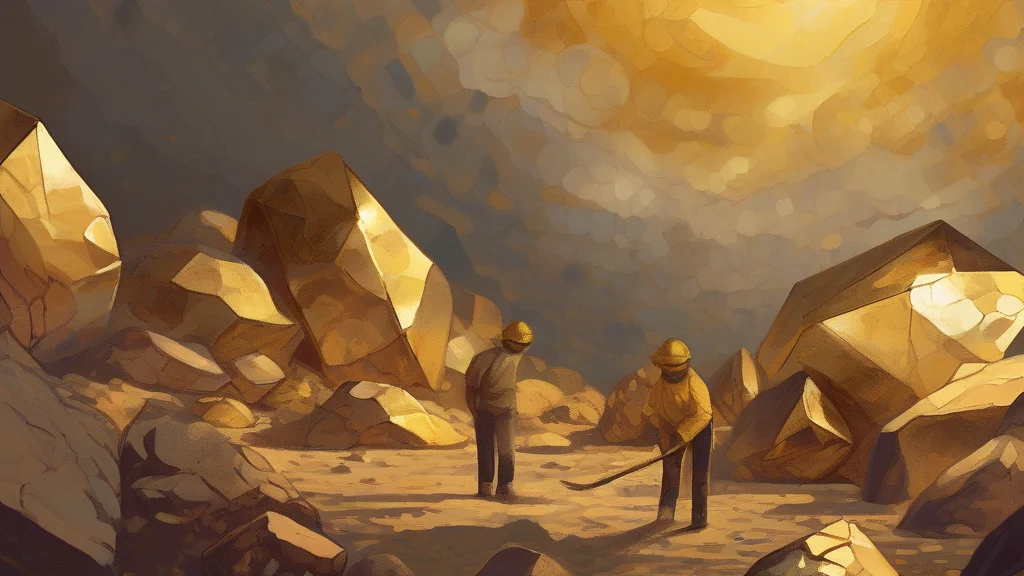
What does chalcopyrite mean?
Chalcopyrite is a brassy-yellow mineral composed of copper iron sulfide, with the chemical formula CuFeS₂. It ranks among the most abundant and widespread minerals in the Earth's crust and serves as the single most important ore of copper, supplying the bulk of the metal extracted worldwide for wiring, plumbing, electronics, and coinage. Crystallizing in the tetragonal system, chalcopyrite often occurs in veins and disseminated deposits alongside quartz, pyrite, and other sulfide minerals. Although its golden sheen invites comparison with pyrite — the famous 'fool's gold' — chalcopyrite is softer, more brittle, and frequently develops a striking iridescent tarnish of blues, purples, and greens as it weathers. The word belongs chiefly to the vocabulary of geology, mining, and mineral collecting, but it surfaces whenever discussions turn to copper sources, ore deposits, or the industrial extraction of metals.
nounA brassy-yellow crystalline mineral consisting of a sulfide of copper and iron (CuFeS₂), and the most important ore of copper.
- The mineral copper iron disulfide (CuFeS₂), brass-yellow in color, occurring widely in igneous and metamorphic rocks and serving as the principal ore of copper.
"The mine's wealth lay in veins of chalcopyrite threaded through the quartz."
"Prospectors identified the chalcopyrite by its brassy luster and greenish streak."
"Under the microscope, the chalcopyrite grains stood out sharply against the surrounding silicates."
Rare; typically used only in geology to refer to separate specimens or occurrences of the mineral.
"The thin section revealed two generations of chalcopyrites with differing textures."
Chalcopyrite is the reason your phone works — it supplies most of the world's copper.
Reviewed by Deb Chak, Editor. AI-assisted content curated by RJS Tech Solutions LLP.
Etymology of chalcopyrite
The word chalcopyrite derives from the Greek 'chalkos', meaning copper, combined with 'pyrites', from the Greek 'pyritēs lithos' or 'stone of fire', a term applied to minerals struck by sparks. It was formed on the model of earlier mineralogical names ending in '-ite'. Its cognates include other copper-related mineral names such as chalcocite and chalcanthite, all tracing back to the same Greek root for copper.
How chalcopyrite is actually used
Chalcopyrite is a technical term used mainly in geology, mining, and mineralogy rather than everyday speech. It is an uncountable mass noun when referring to the substance, though a plural form exists when discussing distinct occurrences or varieties.
Easily confused with chalcopyrite
Pyrite ('fool's gold') is iron sulfide without copper and forms cubic crystals, whereas chalcopyrite is a copper-iron sulfide that is softer and often tarnishes iridescently.
Bornite, or 'peacock ore', shows a distinctive purple-blue iridescent tarnish, while fresh chalcopyrite is brassy yellow.