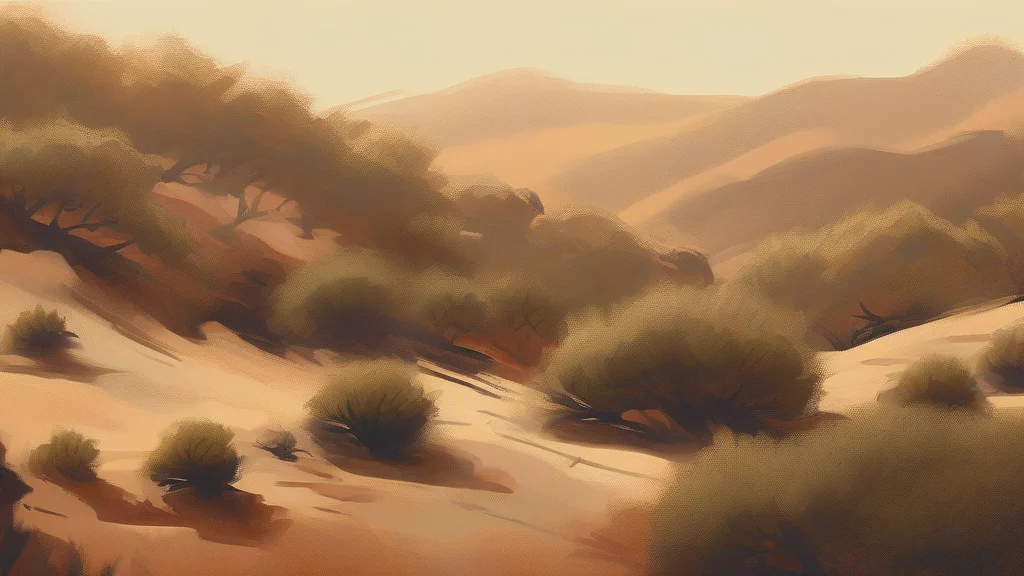
What does chaparral mean?
Chaparral refers to dense, tangled growth of drought-resistant shrubs and low trees—such as manzanita, ceanothus, and scrub oak—that thrives in regions with hot, dry summers and mild, wet winters, most famously in California and Baja California. The word denotes both the vegetation itself and the rugged landscape it covers, and it carries strong associations with wildfire: many chaparral plants are adapted to, and even depend on, periodic burning to reproduce. Beyond botany, the term evokes the American West, appearing frequently in descriptions of hiking trails, ranch country, and ecological studies of Mediterranean-type climates worldwide. It is used chiefly as an uncountable noun, though a plural form exists when referring to distinct patches or regions of this habitat. Borrowed from Spanish, the word adds a distinctly regional color to English and remains essential vocabulary for anyone writing about western landscapes.
Dense, tangled vegetation consisting chiefly of drought-resistant evergreen shrubs and small trees, typical of dry regions with Mediterranean-type climates, especially in the southwestern United States and Mexico.
"The hillside was covered in thick chaparral that cracked and rustled in the summer heat."
Usually treated as an uncountable noun; the plural is uncommon.
A tract of land covered with such dense shrubby growth.
"They hiked for hours through the chaparral before reaching the shaded canyon."
Often used with a definite article when referring to a particular region.
The plural is rare and generally reserved for referring to multiple distinct regions or tracts of chaparral vegetation rather than the vegetation itself, which is normally uncountable.
"The survey compared fire regimes across several coastal chaparrals."
The word 'chapparal' is so often misspelled that even seasoned hikers get it wrong — it takes only one 'p' to tame this wild shrubland.
Reviewed by Deb Chak, Editor. AI-assisted content curated by RJS Tech Solutions LLP.
Etymology of chaparral
Chaparral entered English in the mid-19th century by way of Spanish, where chaparro denoted a dwarf or scrubby evergreen oak. The Spanish word itself derives from the Basque txapar, a diminutive related to saphar, meaning a thicket or undergrowth of scrub oaks. English speakers adopted it to describe the analogous shrublands of the American Southwest, where it became firmly established through exploration, ranching, and later ecological literature.
How chaparral is actually used
Chiefly used in North American contexts, particularly in reference to the southwestern United States and Mexico. In ecology and land-management writing it often appears as part of technical terms for specific plant communities. The plural is rare since the word usually refers to an uncountable mass of vegetation.
Easily confused with chaparral
"Chapparal" is simply a common misspelling of chaparral, not a separate word — the correct spelling has one p.