What does bushland mean?
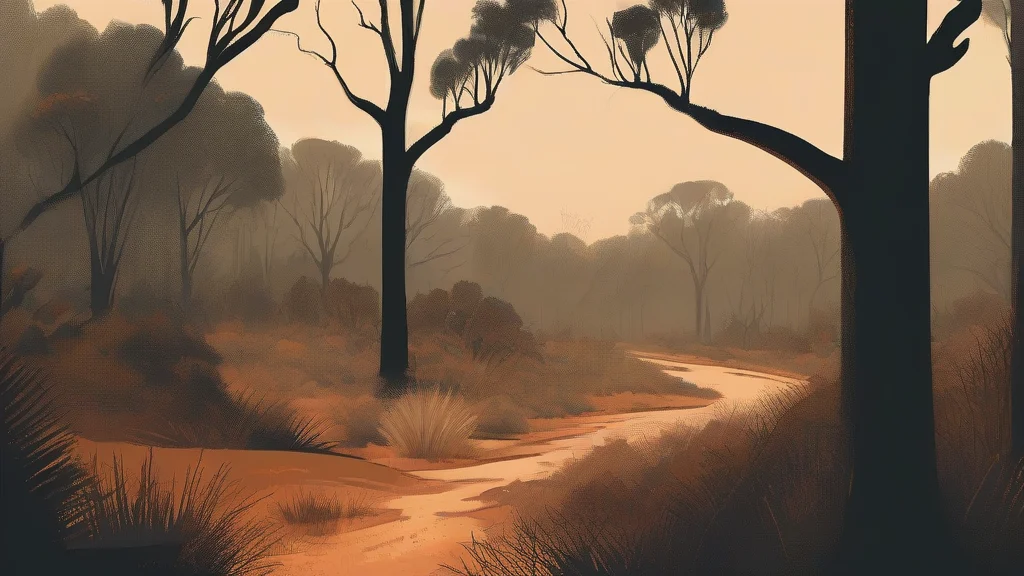
Bushland refers to terrain covered with bushes, shrubs, and small trees — wild, uncultivated land that falls short of being dense forest. The word is especially prominent in Australian and New Zealand English, where 'bushland' describes tracts of native vegetation that remain uncleared by agriculture or urban development. There it is far more than a neutral geographic label: it evokes national identity, environmental stewardship, and the outdoor lifestyle associated with 'the bush'. Common collocations include 'native bushland', 'pristine bushland', and 'bushland reserve', reflecting its frequent role in conservation debates and land-use planning. Outside Australasia the word is understood but less common, with terms like scrubland or wilderness often preferred. Whether describing koala habitat, a suburban nature corridor, or a fire-prone landscape, bushland captures a distinctive kind of vegetated, semi-wild terrain.
nounLand that is covered with bushes, shrubs, and small trees rather than dense forest or open grassland. In Australia the term specifically refers to areas of native vegetation that have not been cleared for farming or urban development.
- Land covered with bushes, shrubs, and small trees; uncultivated wild terrain.
- (Australian/NZ English) Areas of native vegetation preserved from clearing, often valued for conservation and recreation.
"The hiking trail winds through pristine bushland teeming with native birds."
"Developers were forced to preserve a strip of remnant bushland along the river."
"Koalas spend most of their lives in eucalypt bushland, rarely descending to the ground."
The plural is rare and mainly appears when referring collectively to multiple distinct bushland areas, such as across regions or reserves; the singular is standard even for extensive areas.
"The state's remaining bushlands are protected under a series of conservation agreements."
In Australia, 'the bush' isn't just scenery — it's practically a national identity, and bushland is the ground it stands on.
Reviewed by Deb Chak, Editor. AI-assisted content curated by RJS Tech Solutions LLP.
Etymology of bushland
Bushland is a compound of 'bush' — in the sense of wild or uncleared country, a usage that developed in colonial North America before being adopted enthusiastically in 19th-century Australia — combined with 'land'. The underlying word 'bush' derives from Middle English, ultimately from Old Norse 'buskr' or related Germanic sources meaning a thicket or shrub. Its cognates include other colonial-era coinages such as 'bushman', 'bushranger', and 'bushfire'. The compound gained particular currency in Australia as European settlement cleared native vegetation, making surviving tracts worth naming.
How bushland is actually used
While comprehensible everywhere, 'bushland' is most idiomatic in Australian and New Zealand English, where it carries strong cultural and conservation connotations. It typically appears in environmental, planning, and recreational contexts rather than everyday casual speech.
Easily confused with bushland
A forest is dominated by large trees forming a closed canopy, whereas bushland is characterised by lower shrubs and scattered trees.
Scrubland generally denotes dry, open terrain with sparse low shrubs, while bushland is broader and often implies richer native vegetation, particularly in Australian usage.