
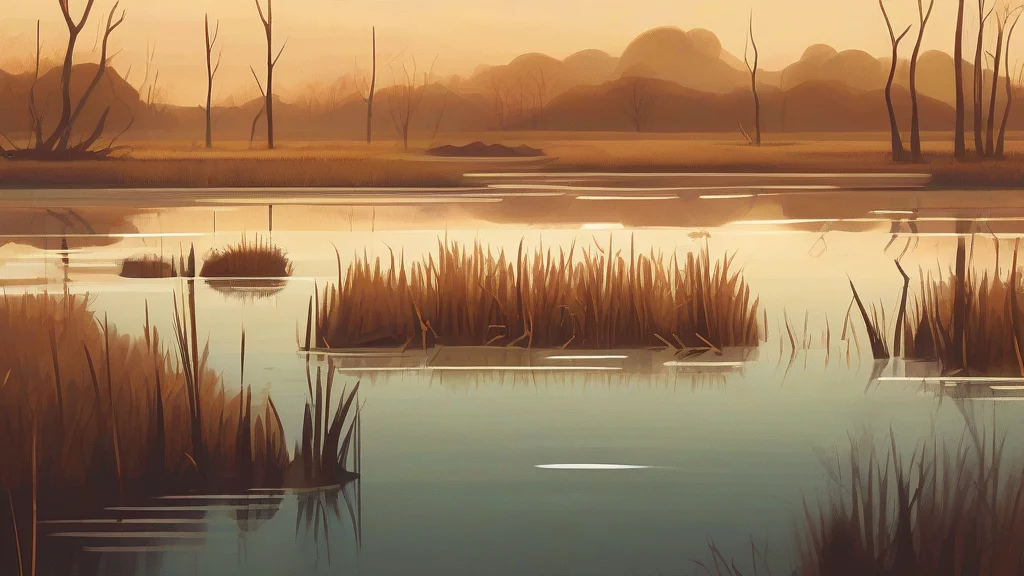
What does wetland mean?
A wetland is an area of land that is regularly or permanently saturated with water. The term includes a wide range of environments, from freshwater marshes, swamps, and fens to salt marshes, mudflats, and peatlands. Some remain wet throughout the year, while others are flooded seasonally. Wetlands are ecologically important because they support specialized plant and animal communities, filter water, absorb pollutants, limit erosion, and reduce the force of floods. The word is especially common in environmental science, conservation, land management, and discussions of climate resilience. In everyday usage, it generally has a neutral or favorable association when referring to the functions performed by wetlands, although particular wetlands may also be vulnerable to pollution, drainage, development, and habitat loss. Attributive forms such as “wetland habitat” and “wetland restoration” are common in professional and public conservation contexts.
nounAn area of land that is regularly saturated with water, either permanently or seasonally. Wetlands may be fresh or salt water and can include marshes, swamps, fens, and tidal flats.
- An area of land that is regularly or permanently saturated with water and supports distinctive plant and animal communities.
"The river floodplain contains a wetland that provides crucial habitat for birds and fish."
"Heavy rainfall turned the low-lying field into a temporary wetland."
"The restoration project returned an abandoned industrial site to productive wetland."
The plural is standard when referring to multiple wetland areas, especially in ecological and conservation contexts.
"Coastal wetlands provide breeding grounds for numerous migratory birds."
Wetlands are natural sponges: they slow floods, filter pollutants, and shelter an extraordinary variety of wildlife.
Reviewed by Deb Chak, Editor. AI-assisted content curated by RJS Tech Solutions LLP.
Where does wetland come from?
“Wetland” is an English compound formed from “wet” and “land,” both of which have Old English origins and ultimately relate to water or moisture. The compound developed in English during the early modern period, initially for describing marshy or water-covered land; its ecological and conservation uses became especially prominent during the twentieth century. Its relatives “water,” “watery,” “waterless,” and “waterlogged” ultimately share the same ancient linguistic roots connected with moisture.
How wetland is actually used
The term is standard in ecology, geography, conservation, and environmental policy. It is usually countable, commonly appears before another noun, and is usually plural when referring to extensive areas or multiple distinct habitats.
Easily confused with wetland
A wetland is land saturated with water, whereas woodland is land covered with trees.