
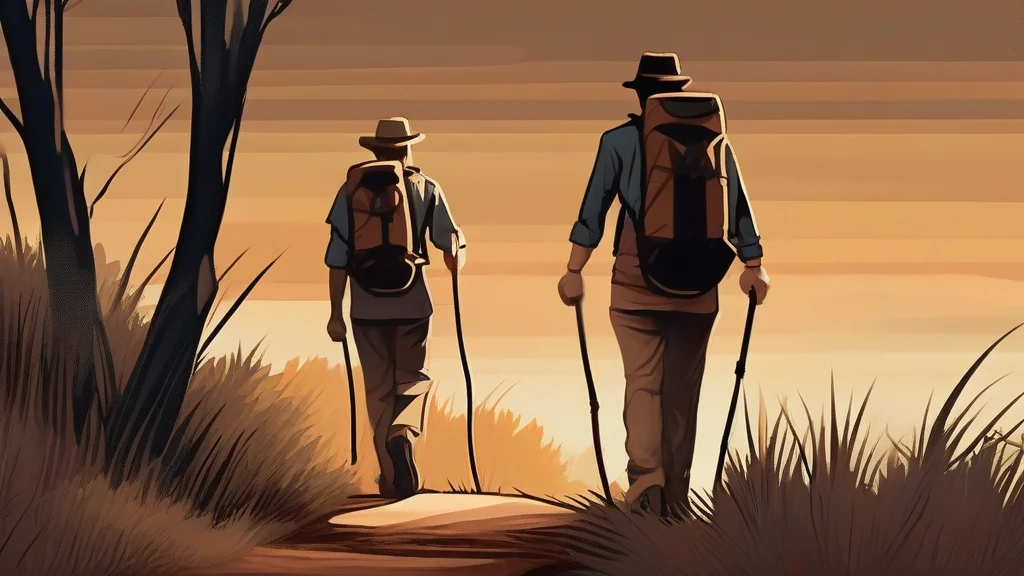
What does bushwalking mean?
Bushwalking is an Australian term for walking or hiking through the bush, meaning open country, woodland or other relatively undeveloped natural terrain. It most often refers to a recreational outing, whether on a maintained trail, in a national park or across more remote country, and carries friendly associations with nature, exercise, exploration and outdoor companionship. The word is the local counterpart of “hiking” and “trekking,” although “tramping” is the more customary term for a similar activity in New Zealand. Bushwalking is normally treated as an uncountable noun, with “bushwalk” available when a single journey needs to be counted. It does not inherently imply overnight travel or camping, since a bushwalk may last only a few hours. The term has also become familiar internationally through Australian travel writing and outdoor culture, but it remains especially associated with the Australian landscape and the active, informal culture of exploring it on foot.
The activity of walking or hiking through the bush, especially for recreation.
"Bushwalking along the coast is popular during the cooler months."
Chiefly Australian and usually uncountable.
Engaged in walking or hiking through the bush.
"They spent Saturday bushwalking near the national park."
This is the present participle of bushwalk and is commonly used in the form “go bushwalking.”
As a mass noun, bushwalking normally does not take a plural form. Use “bushwalks” when referring to individual journeys.
"Their bushwalking club organizes weekend walks throughout the year."
In Australia, “hiking” is often simply called bushwalking: trading pavement for the bush, usually with boots, water and a trail map.
Reviewed by Deb Chak, Editor. AI-assisted content curated by RJS Tech Solutions LLP.
Where does bushwalking come from?
Bushwalking developed in nineteenth-century Australian English by combining “bush,” meaning open country, woodland or wilderness, with “walking.” “Bush” comes through Old English and Proto-Germanic forms and ultimately derives from an Indo-European word for shrub or bush; the related Latin boscus was borrowed into several Romance languages, producing words such as bosque and bosquage. “Walking” derives from Middle English walken, originally meaning to move about or travel on foot.
Related word forms
How bushwalking is actually used
The term is neutral to informal and strongly associated with Australian outdoor culture. It usually describes a recreational journey on foot and does not necessarily imply camping or carrying overnight equipment.
Easily confused with bushwalking
Bushwalking is recreational walking or hiking through the bush, whereas bushwhacking emphasizes travel through difficult or trackless country and can also mean circumventing rules or obstacles.